Weniger Zeit? Mehr Bildschirme. Wie man sich im Zeitalter der Masseninhalte anpasst.

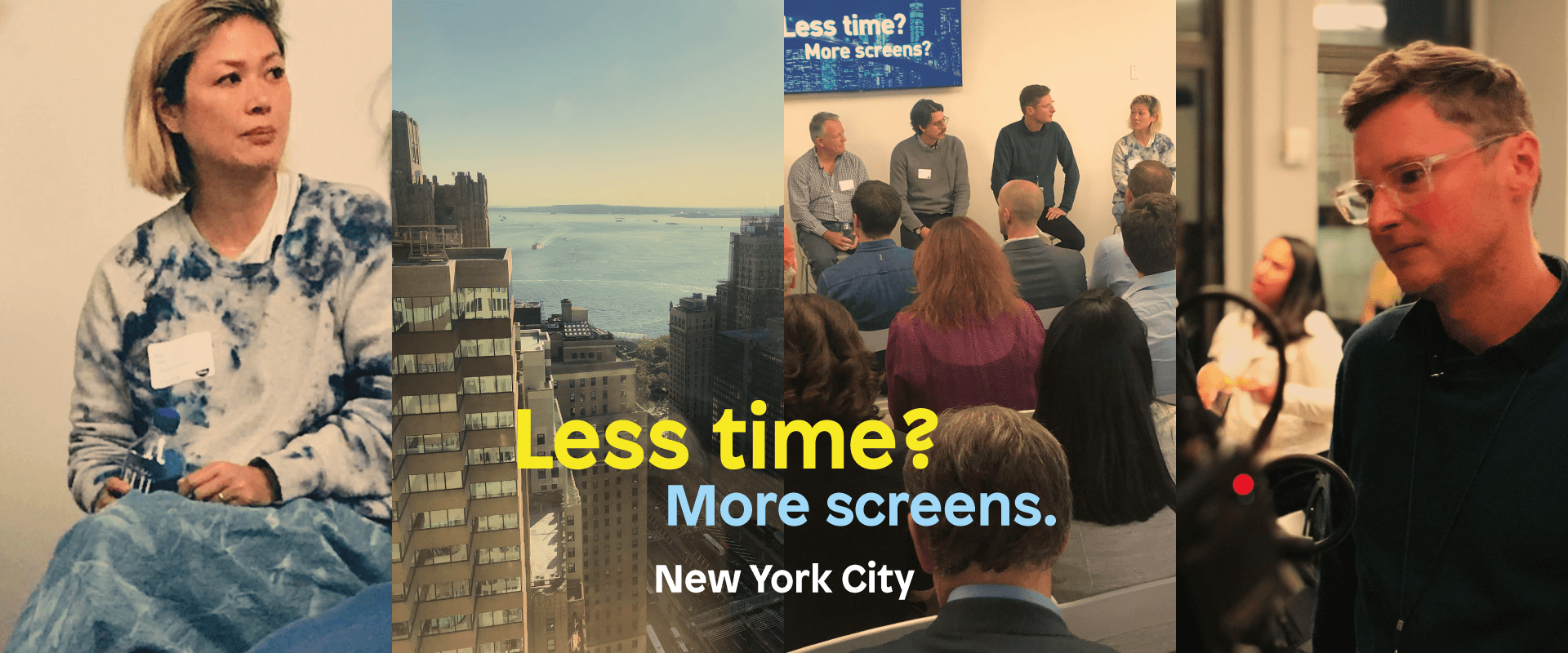
Bei unserer Veranstaltung in New York mit Comcast Technology Solutions, Instagram, Droga5, Publicis, Framestore und MCA äußerten sich Experten dazu, was es für die Branche bedeutet, wenn Bildschirme immer häufiger genutzt werden und Inhalte einen Höchststand erreichen.

Author

Cape.io

Author

Cape.io

Dies wurde ursprünglich auf der Peach-Website veröffentlicht. Erfahren Sie mehr über den Rebrand von Peach zu Cape.io.

Im Jahr 2019 überschwemmen mehr Daten und mehr Inhalte die Kultur mit alarmierender Geschwindigkeit, aber mit erstaunlichen Möglichkeiten für Werbetreibende und die Kreativindustrien. Die aktuellen Veränderungen im Konsumverhalten von Inhalten (aufgrund schnell fortschreitender Technologien) haben gewaltige Veränderungen in der Werbebranche ausgelöst. Kreative und Agenturen müssen sich schneller als je zuvor entwickeln, um in diesem neuen unerforschten Gebiet an der Spitze zu bleiben, das sich oft hinter einem Bildschirm verbirgt. Fähigkeiten, die zuvor nie existierten, sind stark nachgefragt, während andere automatisiert werden.

Um die Komplexitäten zu erforschen, wie wir in dieser weltweiten, plattformübergreifenden und inhaltsreichen Welt zurechtkommen, haben Peach und Comcast Technology Solutions den globalen Direktor des Instagram Creative Shop, Kay Hsu; CCO von Publicis Nordamerika, Andy Bird; Direktor der Filmproduktion bei Droga5, Jesse Brihn; MD bei Framestore, Charles Howell; und Gründer von MCA, Pat Murphy zu einer Roundtable-Diskussion eingeladen, die von Little Black Book Gründer und CEO Matt Cooper moderiert wurde.

Hier zerlegt LBB’s Sunna Naseer die wichtigsten Highlights der prägenden Veranstaltung in New York...

Zielgerichtete digitale Daten

Der Zugang zu Daten war nie einfacher - bis hin zu individuellen Verbraucherstatistiken. Marken und Unternehmen haben nun die Fähigkeit, hochgradig personalisierte und zielgerichtete Kampagnen zu erstellen. LBB’s Matt Cooper fragt das Panel: „Wie geht die Branche mit diesem Wechsel im Ansatz um?“

„Daten bleiben, ob wir es mögen oder nicht“, sagt MCA-Gründer Pat Murphy. „Wenn Sie eine großartige kreative Idee haben, können Daten diese noch effektiver machen. Zusammen genommen ist das meiner Meinung nach riesig.“

Kay Hsu, globaler Direktor des Instagram Creative Shop, beleuchtet diese Problematik: „Wenn Sie sich ansehen, wie Disruptoren Inhalte erstellen, ist das völlig anders als die traditionelle Art einer Agentur, Inhalte zu erstellen. Sie stellen anders ein, sie stellen junge Leute ein, sie nutzen ihre Telefone, sie sind weniger anspruchsvoll. Größere Marken können viel von einigen dieser disruptiven Marken lernen. Die Ausbildung in der Branche ist immer noch recht traditionell, sodass Studenten weniger vorbereitet sind, mit den neuesten Inhaltsanforderungen umzugehen.“

Andy Bird, CCO bei Publicis Nordamerika stimmt zu: „Kreative müssen verschiedene Disziplinen und Fähigkeiten lernen, um sich an den Wandel anzupassen. Die Art und Weise, wie wir Arbeit liefern und die Erwartungen der Kunden haben sich weiterentwickelt. Kreative Strategie entsteht manchmal aus dem Nichts, aber Kunden lieben Fakten, und wenn sie eine wirklich kreative Idee sehen, die aus Daten entstanden ist, lieben sie das. Daten waren vor einigen Jahren ein beängstigendes Wort für Kreative, aber ich denke, das ist inzwischen nicht mehr so.“

Automatisierung & Kreativität: Können sie nebeneinander bestehen?

„Ich hoffe es, denn das ist, wohin wir gehen“, sagt Andy. „Wenn wir das nicht tun, sind wir irgendwie verloren! Es hängt davon ab, wie viel Material Sie automatisieren müssen, und Sie sind sehr eingeschränkt aufgrund der Kosten. Es muss einen besseren Weg geben, die Automatisierung ins System zu bringen. Handwerkskunst ist aber auch wichtig.“

Jesse Brihn, Direktor der Filmproduktion bei Droga5, ergänzt: „Es gibt bestimmte Richtlinien, denen Sie folgen können, um jemanden dazu zu bewegen, etwas zu klicken oder zu benutzen. Sie schaffen einen automatischen Prozess oder Output, aber Sie haben auch unglaublich kluge Leute, die ihre Karriere auf dem Kunsthandwerk aufgebaut haben, Dinge automatisch zu machen. Instagram hat eine ganze Plattform, die auf bewährten Methoden und Richtlinien für die Nutzung basiert, aber Sie würden niemals wollen, dass jemand immer wieder dasselbe innerhalb dieser oder ein Bot dazu tut.“

Pat fasst zusammen: „Am Ende des Tages, wenn Sie keine herausragende Kreativität haben, haben Sie nichts zu automatisieren.“

Enge Budgets

In der gesamten Branche werden Budgets gekürzt, dennoch wird immer noch erwartet, dass die Arbeit genauso wirkungsvoll ist. Dies hat mehr Kreativität erfordert, um mit weniger die gleiche Qualität zu erzielen.

„Der beste Weg, dies zu erreichen, ist die Vorausplanung. Wir sehen den größten Erfolg, wenn Medienagentur und Kreativagentur symbiotisch zusammenarbeiten, um zu planen, welche Assets vor dem Produktionsprozess benötigt werden“, sagt Pat. „Unsere Aufgabe ist nicht Kostensenkung oder Kostenkontrolle. Unsere Aufgabe ist es, ein Budget zu nehmen und den größten Effekt daraus zu erzielen. Wenn wir gut mit den Agenturen zusammenarbeiten, dann erhalten Sie die beste Kreativität.“

Jesse weist darauf hin: „Es geht nicht unbedingt darum, so viel Geld wie möglich zu sparen, denn das wird immer der Fall sein. Es geht darum, die Möglichkeiten zu erweitern, um es korrekt in den richtigen Wegen zu positionieren. Etwas, das als schreckliche Werbung oder schrecklicher Inhalt angesehen werden könnte, ist möglicherweise nicht unbedingt ein schlechtes Stück Arbeit, es könnte einfach nur falsch gezielt sein. Wenn Sie Daten verwenden, um Zielmärkte und Plattformen genau zu bestimmen, dann können Sie Dinge auch mit einem Budget gut machen.“

Lesen Sie den vollständigen Artikel auf LBB oder sehen Sie sich hier das Video des ganzen Events an

Neuigkeiten

Sei der Konkurrenz immer einen Schritt voraus

Neugierig auf die neuesten Trends im Marketing und Werbung? Abonniere unseren monatlichen Promarketers-Newsletter und bleibe informiert.

18.03.2026

No more chocolate at breakfast? Navigating the new LHF ad rules this Easter

As ad compliance requirements evolve in 2026, UK confectionery brands face new restrictions on less healthy food (LHF) advertising. With the January 5 watershed now in effect, ad quality assurance systems must validate timing, placement, and product identifiability to avoid clearance failures this Easter season.

16.03.2026

The future of inclusion: How Cape.io powered Virgin Media Television’s fully accessible ad break during the Men’s Six Nations

As Channel 4’s closed-captioning mandate came into effect in March 2026, Cape.io partnered with Virgin Media Television, Omnicom Media Group and VoiceBox to deliver a truly accessible ad break during the Guinness Men’s Six Nations. More than ad compliance, this moment proved that accessibility can operate at the highest level of live sports broadcasting.

27.02.2026

Navigating Channel 4’s 2026 closed caption mandate

As ad compliance requirements tighten across the UK and Europe, closed captioning has evolved from an accessibility checkbox to a strategic necessity. Whether you're managing CTV campaigns or social media creative, automated ad testing for caption quality is no longer optional - it's fundamental to reaching today's fragmented, multi-screen audiences.

The advertising landscape is facing a seismic shift. By March 1, Channel 4 will become the first UK broadcaster to mandate closed captions across all advertising - including linear TV, streaming, and sponsorships.

The mandate is  a redefined standard for global inclusivity. Here is everything you need to know about the new mandate and how to stay ahead of the curve.

26.02.2026

One platform, many realities: How creative automation platforms resolve the global vs. local tension

Scaling global marketing without losing local relevance requires more than brand guidelines and templates - it requires a creative automation platform designed for both global control and local flexibility. Most systems optimize for standardization, but scaling ad creative production across markets demands architecture that enables creative variation and adaptation by local experts without fragmenting brand governance.

Many global advertisers are chasing the same ideal: scale without losing relevance.

Consistency without uniformity.
Efficiency without bureaucracy.

It sounds simple. In practice, it’s one of the hardest tensions to resolve in modern marketing.

The global vs. local challenge isn’t new, but it’s becoming more urgent. As brands expand across markets, channels, and cultures, the question is no longer whether you should scale globally, but how you do so without erasing the nuance that makes marketing effective in the first place.

Everyone is looking for this balance. Very few get it right.

11.02.2026

EPTVI Initiative launches Stage Two to help programmatic TV scale across Europe’s largest advertising markets

Broadcasters, streamers, agencies and ad tech companies including Google Ad Manager, Equativ, Adform, LiveRamp, The Trade Desk, FreeWheel and Cape.io begin work on practical solutions to reduce complexity and speed up adoption.

04.02.2026

The guardrails of growth: Why creative intelligence demands compliance

Generative AI can produce thousands of creative variants, but most compliance systems are still manual, fragmented, and reactive, unable to keep pace with today’s velocity. To move fast without breaking things, the industry needs a new approach: real-time verification, programmatic enforcement, and end-to-end visibility. Embedded inside the stack, not bolted on at the end.

Neuigkeiten

Sei der Konkurrenz immer einen Schritt voraus

Neugierig auf die neuesten Trends im Marketing und Werbung? Abonniere unseren monatlichen Promarketers-Newsletter und bleibe informiert.

18.03.2026

No more chocolate at breakfast? Navigating the new LHF ad rules this Easter

As ad compliance requirements evolve in 2026, UK confectionery brands face new restrictions on less healthy food (LHF) advertising. With the January 5 watershed now in effect, ad quality assurance systems must validate timing, placement, and product identifiability to avoid clearance failures this Easter season.

16.03.2026

The future of inclusion: How Cape.io powered Virgin Media Television’s fully accessible ad break during the Men’s Six Nations

As Channel 4’s closed-captioning mandate came into effect in March 2026, Cape.io partnered with Virgin Media Television, Omnicom Media Group and VoiceBox to deliver a truly accessible ad break during the Guinness Men’s Six Nations. More than ad compliance, this moment proved that accessibility can operate at the highest level of live sports broadcasting.

27.02.2026

Navigating Channel 4’s 2026 closed caption mandate

As ad compliance requirements tighten across the UK and Europe, closed captioning has evolved from an accessibility checkbox to a strategic necessity. Whether you're managing CTV campaigns or social media creative, automated ad testing for caption quality is no longer optional - it's fundamental to reaching today's fragmented, multi-screen audiences.

The advertising landscape is facing a seismic shift. By March 1, Channel 4 will become the first UK broadcaster to mandate closed captions across all advertising - including linear TV, streaming, and sponsorships.

The mandate is  a redefined standard for global inclusivity. Here is everything you need to know about the new mandate and how to stay ahead of the curve.

26.02.2026

One platform, many realities: How creative automation platforms resolve the global vs. local tension

Scaling global marketing without losing local relevance requires more than brand guidelines and templates - it requires a creative automation platform designed for both global control and local flexibility. Most systems optimize for standardization, but scaling ad creative production across markets demands architecture that enables creative variation and adaptation by local experts without fragmenting brand governance.

Many global advertisers are chasing the same ideal: scale without losing relevance.

Consistency without uniformity.
Efficiency without bureaucracy.

It sounds simple. In practice, it’s one of the hardest tensions to resolve in modern marketing.

The global vs. local challenge isn’t new, but it’s becoming more urgent. As brands expand across markets, channels, and cultures, the question is no longer whether you should scale globally, but how you do so without erasing the nuance that makes marketing effective in the first place.

Everyone is looking for this balance. Very few get it right.

11.02.2026

EPTVI Initiative launches Stage Two to help programmatic TV scale across Europe’s largest advertising markets

Broadcasters, streamers, agencies and ad tech companies including Google Ad Manager, Equativ, Adform, LiveRamp, The Trade Desk, FreeWheel and Cape.io begin work on practical solutions to reduce complexity and speed up adoption.

04.02.2026

The guardrails of growth: Why creative intelligence demands compliance

Generative AI can produce thousands of creative variants, but most compliance systems are still manual, fragmented, and reactive, unable to keep pace with today’s velocity. To move fast without breaking things, the industry needs a new approach: real-time verification, programmatic enforcement, and end-to-end visibility. Embedded inside the stack, not bolted on at the end.

Neuigkeiten

Sei der Konkurrenz immer einen Schritt voraus

Neugierig auf die neuesten Trends im Marketing und Werbung? Abonniere unseren monatlichen Promarketers-Newsletter und bleibe informiert.

18.03.2026

No more chocolate at breakfast? Navigating the new LHF ad rules this Easter

As ad compliance requirements evolve in 2026, UK confectionery brands face new restrictions on less healthy food (LHF) advertising. With the January 5 watershed now in effect, ad quality assurance systems must validate timing, placement, and product identifiability to avoid clearance failures this Easter season.

16.03.2026

The future of inclusion: How Cape.io powered Virgin Media Television’s fully accessible ad break during the Men’s Six Nations

As Channel 4’s closed-captioning mandate came into effect in March 2026, Cape.io partnered with Virgin Media Television, Omnicom Media Group and VoiceBox to deliver a truly accessible ad break during the Guinness Men’s Six Nations. More than ad compliance, this moment proved that accessibility can operate at the highest level of live sports broadcasting.

27.02.2026

Navigating Channel 4’s 2026 closed caption mandate

As ad compliance requirements tighten across the UK and Europe, closed captioning has evolved from an accessibility checkbox to a strategic necessity. Whether you're managing CTV campaigns or social media creative, automated ad testing for caption quality is no longer optional - it's fundamental to reaching today's fragmented, multi-screen audiences.

The advertising landscape is facing a seismic shift. By March 1, Channel 4 will become the first UK broadcaster to mandate closed captions across all advertising - including linear TV, streaming, and sponsorships.

The mandate is  a redefined standard for global inclusivity. Here is everything you need to know about the new mandate and how to stay ahead of the curve.

26.02.2026

One platform, many realities: How creative automation platforms resolve the global vs. local tension

Scaling global marketing without losing local relevance requires more than brand guidelines and templates - it requires a creative automation platform designed for both global control and local flexibility. Most systems optimize for standardization, but scaling ad creative production across markets demands architecture that enables creative variation and adaptation by local experts without fragmenting brand governance.

Many global advertisers are chasing the same ideal: scale without losing relevance.

Consistency without uniformity.
Efficiency without bureaucracy.

It sounds simple. In practice, it’s one of the hardest tensions to resolve in modern marketing.

The global vs. local challenge isn’t new, but it’s becoming more urgent. As brands expand across markets, channels, and cultures, the question is no longer whether you should scale globally, but how you do so without erasing the nuance that makes marketing effective in the first place.

Everyone is looking for this balance. Very few get it right.

11.02.2026

EPTVI Initiative launches Stage Two to help programmatic TV scale across Europe’s largest advertising markets

Broadcasters, streamers, agencies and ad tech companies including Google Ad Manager, Equativ, Adform, LiveRamp, The Trade Desk, FreeWheel and Cape.io begin work on practical solutions to reduce complexity and speed up adoption.

04.02.2026

The guardrails of growth: Why creative intelligence demands compliance

Generative AI can produce thousands of creative variants, but most compliance systems are still manual, fragmented, and reactive, unable to keep pace with today’s velocity. To move fast without breaking things, the industry needs a new approach: real-time verification, programmatic enforcement, and end-to-end visibility. Embedded inside the stack, not bolted on at the end.

Kontakt aufnehmen

Lassen Sie uns Ihnen zeigen, was Cape.io leisten kann.

Intelligente Kampagnenautomatisierung

Cape.io vernetzt Ihr Team, DAM, Ad-Server, DSPs, Tools und mehr, sodass Sie nichts herausreißen oder ersetzen müssen.

Copyright © 2025 Cape.io alle Rechte vorbehalten

Deutsch

Kontakt aufnehmen

Lassen Sie uns Ihnen zeigen, was Cape.io leisten kann.

Intelligente Kampagnenautomatisierung

Cape.io vernetzt Ihr Team, DAM, Ad-Server, DSPs, Tools und mehr, sodass Sie nichts herausreißen oder ersetzen müssen.

Copyright © 2025 Cape.io alle Rechte vorbehalten

Deutsch

Kontakt aufnehmen

Lassen Sie uns Ihnen zeigen, was Cape.io leisten kann.

Intelligente Kampagnenautomatisierung

Cape.io vernetzt Ihr Team, DAM, Ad-Server, DSPs, Tools und mehr, sodass Sie nichts herausreißen oder ersetzen müssen.

Copyright © 2025 Cape.io alle Rechte vorbehalten

Deutsch