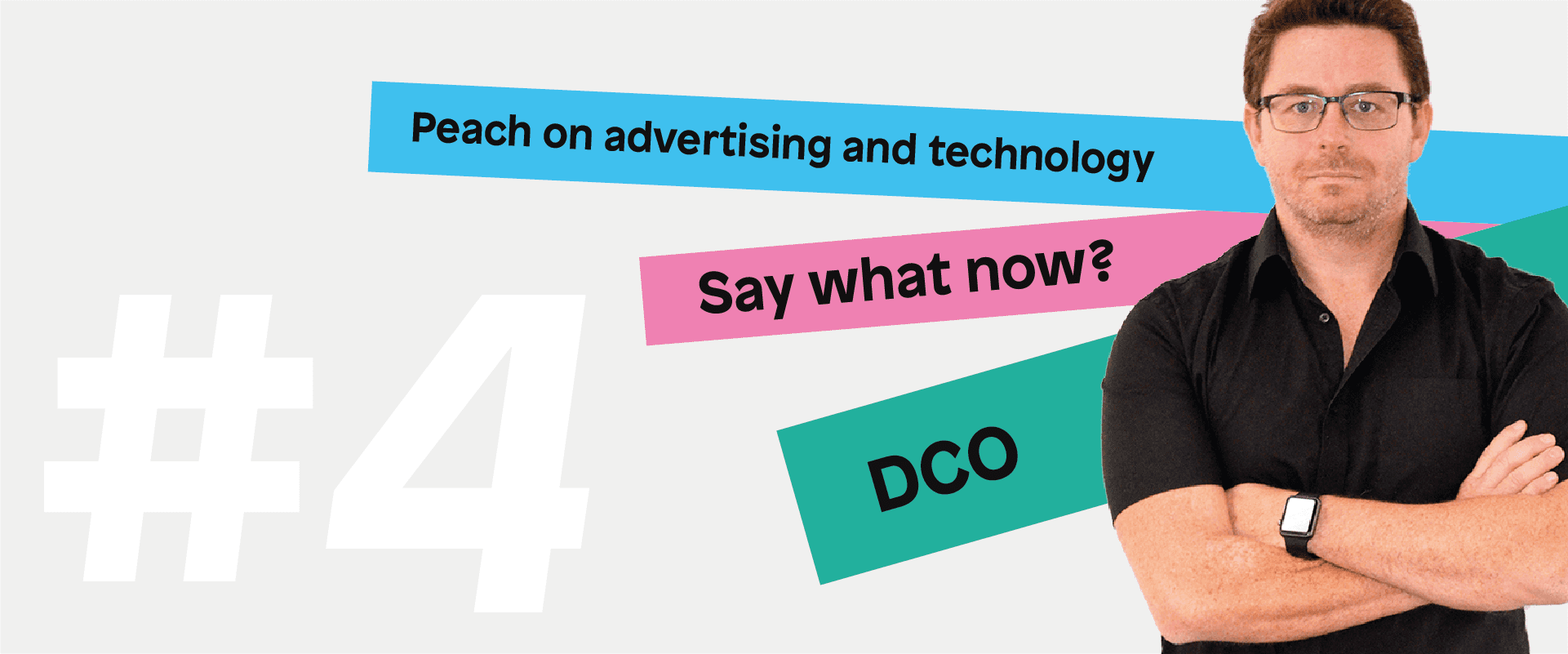
Say What Now? Nr. 4: DCO: Eine Gelegenheit, Kreativität neu zu gestalten

Craig Russill-Roy erklärt, wie das Verständnis von dynamischer Kreativoptimierung uns einen Einblick in die Zukunft der Branche geben kann

Author

Cape.io

Author

Cape.io

Dieser Blog-Beitrag wurde ursprünglich auf der Website von Peach veröffentlicht. Erfahren Sie mehr über das Rebranding von Peach zu Cape.io.

Würden Sie lieber zwanzig neue Kreative einstellen oder zwanzig neue Datenexperten? Wie Agenturen diese Frage beantworten, wird uns viel darüber verraten, wie die kreative Welt nach Covid aussehen wird. 

Das Potenzial für Spannungen zwischen Kreativität und Daten ist natürlich nichts Neues. Schon seit Jahren stützen sich Marketer auf zunehmend detaillierte Daten, um mit Verbrauchern auf eine Weise zu kommunizieren, die ihre Kampagnen (theoretisch) relevanter und effektiver macht. Der Sweet Spot für alle Beteiligten entsteht, wenn Daten und Kreativität Hand in Hand arbeiten - und genau hier kommt die dynamische kreative Optimierung (DCO) ins Spiel. 

Einführung in DCO

Dynamische kreative Optimierung ist im Wesentlichen die digitale Kunst, die richtige Person mit der richtigen Botschaft zu erreichen. Wenn zum Beispiel ein Herr namens Dan nach Hotels in Madrid sucht, wird er erstaunlicherweise feststellen, dass er das nächste Mal, wenn er online ist, Werbung für die besten Touristenattraktionen sieht, die Madrid zu bieten hat. 

Das liegt daran, dass im Hintergrund ein Prozess läuft, bei dem Dans Webbrowser in 100 Millisekunden all seine Cookies und Daten sowie die nahezu zahllosen Werbungen abwägt, die für den verfügbaren Platz entworfen wurden, und entscheidet, dass das Erkunden von Madrid für Dan gerade ziemlich interessant sein wird. Dieselben Daten wurden auch verwendet, um genau zu entscheiden, welche Bilder und Texte Dan am liebsten in die Werbung integriert sehen möchte. Das ist DCO, und es ist ein Prozess, der einen großen Teil der Entwicklung unserer Branche ins 21. Jahrhundert definiert hat. 

Im Laufe der Zeit ist der Prozess auch viel ausgefeilter geworden. Kreative haben jetzt die Möglichkeit, mit zunehmend beeindruckenden Assets zu spielen und können Daten nutzen, um Dan zu zeigen, wo der beste Ort für Paella ist, der weniger als 15 Minuten vom Flughafen Madrid Barajas entfernt ist. Die Technik hat einen weiten Weg hinter sich und hat noch viel vor sich.

Ein Fenster zur Zukunft?

Auf die Gefahr hin, ein Gefangener des Schicksals zu werden, gibt es derzeit viel auf der Welt, das uns zeigen kann, wie sich DCO in naher Zukunft verändern wird. 

Zum Beispiel gibt es einen schmalen Grat zwischen Werbung, die ‚relevant‘ ist, und Werbung, die einfach nur aufdringlich ist. Nur weil Sie Mikrosegmentierung betreiben können, bedeutet das nicht, dass Sie es sollten. Nutzen Sie die Wissenschaft, lassen Sie sich aber nicht von ihr blenden. 

So wie niemand kalte Anrufer mag, werden Werbungen, die sich ständig wiederholen und aufdringlich sind, in der Regel am wenigsten effektiv. Daher gibt es allen Grund zu der Annahme, dass die erfolgreichen Werbungen der Zukunft diejenigen sein werden, die die Vorteile zielgerichteter datengetriebener Ansätze und großartige kreative Arbeit miteinander verbinden.

Zudem müssen wir uns der Wege bewusst sein, wie der DCO-Prozess sich anpassen muss, um weiterhin an der Spitze zu bleiben. Beispielsweise werden unsere Werbungen derzeit mit der Sprache ‚er‘ und ‚sie‘ erstellt und vermittelt. Aber natürlich werden sich in naher Zukunft viele Konsumenten als ‚sie‘ identifizieren. Für eine Branche, die so persönlich relevant wie möglich sein muss, ist das eine große und wesentliche Veränderung. 

"Die erfolgreichen Werbungen der Zukunft werden diejenigen sein, die die Vorteile zielgerichteter datengetriebener Ansätze und großartige kreative Arbeit verbinden"

Ein weiterer Bereich, in dem der DCO-Prozess unserer Branche die Zukunft zeigen kann, ist die Art der Verantwortlichkeit. Derzeit ist es ein Klischee, aber dennoch wahr, dass die Welt der Online-Werbung ein wenig wie der Wilde Westen ist. Agenturen arbeiten mit Berichten aus ihren Kampagnen, die möglicherweise auf irreführenden Daten basieren – beispielsweise, war eine Werbung nicht effektiv, weil sie schlecht war, oder weil jemand irgendwo entlang der Linie seine Messungen einen Pixel daneben hatte und die Werbung nicht richtig angezeigt wurde? 

Wir sind an einem Punkt angelangt, an dem wir dringend irgendeine Art von Regulierungsstelle benötigen, um Standards zu setzen und Gesetze zu erlassen, in einer derzeit recht gesetzlosen Welt. Für das Fernsehen im Vereinigten Königreich gibt es Clearcast, während es in Frankreich die ARPP gibt – weltweit gibt es jedoch nur wenig Regulierung für die Online-Welt. 

Das Verständnis des Prozesses der dynamischen kreativen Optimierung ist lehrreich. Wenn unsere Branche die Antworten auf die Herausforderungen finden kann, die sie beleuchtet, dann können wir beginnen, eine strahlende neue Zukunft zu skizzieren, in der Kreativität und Daten das Beste in einander hervorbringen.

Zwanzig neue Kreative oder zwanzig neue Datenstrategen? Die beste Agentur der Zukunft wird jetzt zehn von jedem einstellen. 

Neuigkeiten

Sei der Konkurrenz immer einen Schritt voraus

Neugierig auf die neuesten Trends im Marketing und Werbung? Abonniere unseren monatlichen Promarketers-Newsletter und bleibe informiert.

18.03.2026

No more chocolate at breakfast? Navigating the new LHF ad rules this Easter

As ad compliance requirements evolve in 2026, UK confectionery brands face new restrictions on less healthy food (LHF) advertising. With the January 5 watershed now in effect, ad quality assurance systems must validate timing, placement, and product identifiability to avoid clearance failures this Easter season.

16.03.2026

The future of inclusion: How Cape.io powered Virgin Media Television’s fully accessible ad break during the Men’s Six Nations

As Channel 4’s closed-captioning mandate came into effect in March 2026, Cape.io partnered with Virgin Media Television, Omnicom Media Group and VoiceBox to deliver a truly accessible ad break during the Guinness Men’s Six Nations. More than ad compliance, this moment proved that accessibility can operate at the highest level of live sports broadcasting.

27.02.2026

Navigating Channel 4’s 2026 closed caption mandate

As ad compliance requirements tighten across the UK and Europe, closed captioning has evolved from an accessibility checkbox to a strategic necessity. Whether you're managing CTV campaigns or social media creative, automated ad testing for caption quality is no longer optional - it's fundamental to reaching today's fragmented, multi-screen audiences.

The advertising landscape is facing a seismic shift. By March 1, Channel 4 will become the first UK broadcaster to mandate closed captions across all advertising - including linear TV, streaming, and sponsorships.

The mandate is  a redefined standard for global inclusivity. Here is everything you need to know about the new mandate and how to stay ahead of the curve.

26.02.2026

One platform, many realities: How creative automation platforms resolve the global vs. local tension

Scaling global marketing without losing local relevance requires more than brand guidelines and templates - it requires a creative automation platform designed for both global control and local flexibility. Most systems optimize for standardization, but scaling ad creative production across markets demands architecture that enables creative variation and adaptation by local experts without fragmenting brand governance.

Many global advertisers are chasing the same ideal: scale without losing relevance.

Consistency without uniformity.
Efficiency without bureaucracy.

It sounds simple. In practice, it’s one of the hardest tensions to resolve in modern marketing.

The global vs. local challenge isn’t new, but it’s becoming more urgent. As brands expand across markets, channels, and cultures, the question is no longer whether you should scale globally, but how you do so without erasing the nuance that makes marketing effective in the first place.

Everyone is looking for this balance. Very few get it right.

11.02.2026

EPTVI Initiative launches Stage Two to help programmatic TV scale across Europe’s largest advertising markets

Broadcasters, streamers, agencies and ad tech companies including Google Ad Manager, Equativ, Adform, LiveRamp, The Trade Desk, FreeWheel and Cape.io begin work on practical solutions to reduce complexity and speed up adoption.

04.02.2026

The guardrails of growth: Why creative intelligence demands compliance

Generative AI can produce thousands of creative variants, but most compliance systems are still manual, fragmented, and reactive, unable to keep pace with today’s velocity. To move fast without breaking things, the industry needs a new approach: real-time verification, programmatic enforcement, and end-to-end visibility. Embedded inside the stack, not bolted on at the end.

Neuigkeiten

Sei der Konkurrenz immer einen Schritt voraus

Neugierig auf die neuesten Trends im Marketing und Werbung? Abonniere unseren monatlichen Promarketers-Newsletter und bleibe informiert.

18.03.2026

No more chocolate at breakfast? Navigating the new LHF ad rules this Easter

As ad compliance requirements evolve in 2026, UK confectionery brands face new restrictions on less healthy food (LHF) advertising. With the January 5 watershed now in effect, ad quality assurance systems must validate timing, placement, and product identifiability to avoid clearance failures this Easter season.

16.03.2026

The future of inclusion: How Cape.io powered Virgin Media Television’s fully accessible ad break during the Men’s Six Nations

As Channel 4’s closed-captioning mandate came into effect in March 2026, Cape.io partnered with Virgin Media Television, Omnicom Media Group and VoiceBox to deliver a truly accessible ad break during the Guinness Men’s Six Nations. More than ad compliance, this moment proved that accessibility can operate at the highest level of live sports broadcasting.

27.02.2026

Navigating Channel 4’s 2026 closed caption mandate

As ad compliance requirements tighten across the UK and Europe, closed captioning has evolved from an accessibility checkbox to a strategic necessity. Whether you're managing CTV campaigns or social media creative, automated ad testing for caption quality is no longer optional - it's fundamental to reaching today's fragmented, multi-screen audiences.

The advertising landscape is facing a seismic shift. By March 1, Channel 4 will become the first UK broadcaster to mandate closed captions across all advertising - including linear TV, streaming, and sponsorships.

The mandate is  a redefined standard for global inclusivity. Here is everything you need to know about the new mandate and how to stay ahead of the curve.

26.02.2026

One platform, many realities: How creative automation platforms resolve the global vs. local tension

Scaling global marketing without losing local relevance requires more than brand guidelines and templates - it requires a creative automation platform designed for both global control and local flexibility. Most systems optimize for standardization, but scaling ad creative production across markets demands architecture that enables creative variation and adaptation by local experts without fragmenting brand governance.

Many global advertisers are chasing the same ideal: scale without losing relevance.

Consistency without uniformity.
Efficiency without bureaucracy.

It sounds simple. In practice, it’s one of the hardest tensions to resolve in modern marketing.

The global vs. local challenge isn’t new, but it’s becoming more urgent. As brands expand across markets, channels, and cultures, the question is no longer whether you should scale globally, but how you do so without erasing the nuance that makes marketing effective in the first place.

Everyone is looking for this balance. Very few get it right.

11.02.2026

EPTVI Initiative launches Stage Two to help programmatic TV scale across Europe’s largest advertising markets

Broadcasters, streamers, agencies and ad tech companies including Google Ad Manager, Equativ, Adform, LiveRamp, The Trade Desk, FreeWheel and Cape.io begin work on practical solutions to reduce complexity and speed up adoption.

04.02.2026

The guardrails of growth: Why creative intelligence demands compliance

Generative AI can produce thousands of creative variants, but most compliance systems are still manual, fragmented, and reactive, unable to keep pace with today’s velocity. To move fast without breaking things, the industry needs a new approach: real-time verification, programmatic enforcement, and end-to-end visibility. Embedded inside the stack, not bolted on at the end.

Neuigkeiten

Sei der Konkurrenz immer einen Schritt voraus

Neugierig auf die neuesten Trends im Marketing und Werbung? Abonniere unseren monatlichen Promarketers-Newsletter und bleibe informiert.

18.03.2026

No more chocolate at breakfast? Navigating the new LHF ad rules this Easter

As ad compliance requirements evolve in 2026, UK confectionery brands face new restrictions on less healthy food (LHF) advertising. With the January 5 watershed now in effect, ad quality assurance systems must validate timing, placement, and product identifiability to avoid clearance failures this Easter season.

16.03.2026

The future of inclusion: How Cape.io powered Virgin Media Television’s fully accessible ad break during the Men’s Six Nations

As Channel 4’s closed-captioning mandate came into effect in March 2026, Cape.io partnered with Virgin Media Television, Omnicom Media Group and VoiceBox to deliver a truly accessible ad break during the Guinness Men’s Six Nations. More than ad compliance, this moment proved that accessibility can operate at the highest level of live sports broadcasting.

27.02.2026

Navigating Channel 4’s 2026 closed caption mandate

As ad compliance requirements tighten across the UK and Europe, closed captioning has evolved from an accessibility checkbox to a strategic necessity. Whether you're managing CTV campaigns or social media creative, automated ad testing for caption quality is no longer optional - it's fundamental to reaching today's fragmented, multi-screen audiences.

The advertising landscape is facing a seismic shift. By March 1, Channel 4 will become the first UK broadcaster to mandate closed captions across all advertising - including linear TV, streaming, and sponsorships.

The mandate is  a redefined standard for global inclusivity. Here is everything you need to know about the new mandate and how to stay ahead of the curve.

26.02.2026

One platform, many realities: How creative automation platforms resolve the global vs. local tension

Scaling global marketing without losing local relevance requires more than brand guidelines and templates - it requires a creative automation platform designed for both global control and local flexibility. Most systems optimize for standardization, but scaling ad creative production across markets demands architecture that enables creative variation and adaptation by local experts without fragmenting brand governance.

Many global advertisers are chasing the same ideal: scale without losing relevance.

Consistency without uniformity.
Efficiency without bureaucracy.

It sounds simple. In practice, it’s one of the hardest tensions to resolve in modern marketing.

The global vs. local challenge isn’t new, but it’s becoming more urgent. As brands expand across markets, channels, and cultures, the question is no longer whether you should scale globally, but how you do so without erasing the nuance that makes marketing effective in the first place.

Everyone is looking for this balance. Very few get it right.

11.02.2026

EPTVI Initiative launches Stage Two to help programmatic TV scale across Europe’s largest advertising markets

Broadcasters, streamers, agencies and ad tech companies including Google Ad Manager, Equativ, Adform, LiveRamp, The Trade Desk, FreeWheel and Cape.io begin work on practical solutions to reduce complexity and speed up adoption.

04.02.2026

The guardrails of growth: Why creative intelligence demands compliance

Generative AI can produce thousands of creative variants, but most compliance systems are still manual, fragmented, and reactive, unable to keep pace with today’s velocity. To move fast without breaking things, the industry needs a new approach: real-time verification, programmatic enforcement, and end-to-end visibility. Embedded inside the stack, not bolted on at the end.

Kontakt aufnehmen

Lassen Sie uns Ihnen zeigen, was Cape.io leisten kann.

Intelligente Kampagnenautomatisierung

Cape.io vernetzt Ihr Team, DAM, Ad-Server, DSPs, Tools und mehr, sodass Sie nichts herausreißen oder ersetzen müssen.

Copyright © 2025 Cape.io alle Rechte vorbehalten

Deutsch

Kontakt aufnehmen

Lassen Sie uns Ihnen zeigen, was Cape.io leisten kann.

Intelligente Kampagnenautomatisierung

Cape.io vernetzt Ihr Team, DAM, Ad-Server, DSPs, Tools und mehr, sodass Sie nichts herausreißen oder ersetzen müssen.

Copyright © 2025 Cape.io alle Rechte vorbehalten

Deutsch

Kontakt aufnehmen

Lassen Sie uns Ihnen zeigen, was Cape.io leisten kann.

Intelligente Kampagnenautomatisierung

Cape.io vernetzt Ihr Team, DAM, Ad-Server, DSPs, Tools und mehr, sodass Sie nichts herausreißen oder ersetzen müssen.

Copyright © 2025 Cape.io alle Rechte vorbehalten

Deutsch