Mniej czasu? Więcej ekranów. Jak dostosować się w epoce masowej treści

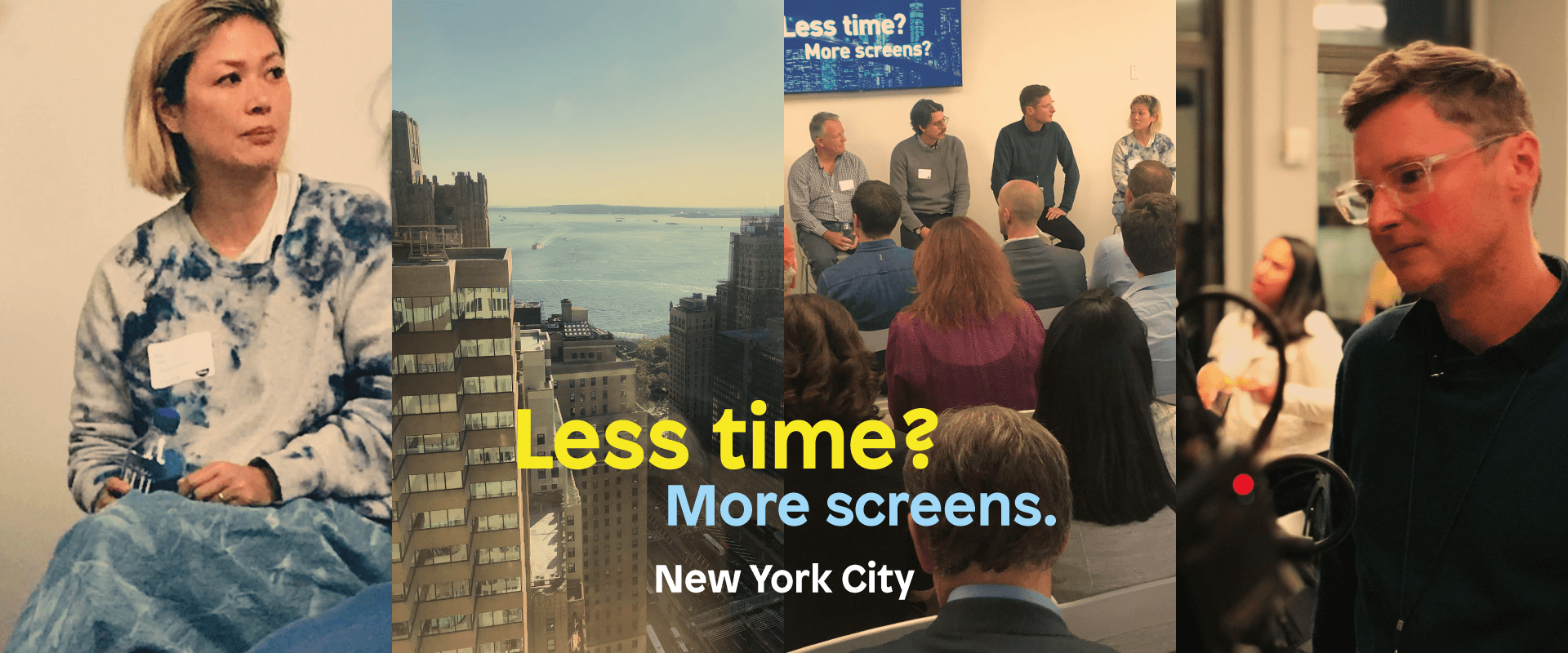
Podczas naszego wydarzenia w Nowym Jorku wraz z Comcast Technology Solutions, Instagram, Droga5, Publicis, Framestore i MCA omówiliśmy, co oznacza dla branży, gdy ekrany zyskują na znaczeniu, a treści są na rekordowym poziomie.

Author

Cape.io

Author

Cape.io

To zostało pierwotnie opublikowane na stronie internetowej Peach. Dowiedz się więcej o zmianie marki z Peach na Cape.io.

W 2019 roku więcej danych i treści zalewa kulturę w alarmującym tempie, ale z niesamowitą szansą dla reklamodawców i przemysłów kreatywnych. Ostatnie zmiany w zachowaniach związanych z konsumpcją treści (w wyniku szybko postępującej technologii) wywołały fale zmian w branży reklamowej. Kreatywni i agencje muszą ewoluować szybciej niż kiedykolwiek, aby nadążyć za tym nowym, nieznanym terytorium, znaczna część którego znajduje się za ekranem. Umiejętności, które nigdy wcześniej nie istniały, są bardzo poszukiwane, podczas gdy inne są automatyzowane.

Aby zagłębić się w złożoność tego, jak nadążamy w tym wieloplatformowym, bogatym w treści świecie, Peach i Comcast Technology Solutions zaprosili globalnego dyrektora Instagram Creative Shop, Kay Hsu; COO Publicis North America, Andy'ego Birda; dyrektora produkcji filmowej w Droga5, Jesse Brihna; MD w Framestore, Charlesa Howella; oraz założyciela MCA, Pat Murphy do dyskusji okrągłego stołu prowadzonej przez założyciela i CEO Little Black Book, Matta Coopera.

Tutaj Sunna Naseer z LBB przedstawia kluczowe punkty z formacyjnego wydarzenia w Nowym Jorku...

Docelowe dane Digital

Dostęp do danych nigdy nie był łatwiejszy - aż do indywidualnych statystyk konsumenckich. Marki i firmy mają teraz możliwość tworzenia wysoko spersonalizowanych i ukierunkowanych kampanii. Matt Cooper z LBB pyta panel, „Jak branża radzi sobie z tą zmianą podejścia?”

„Dane są tutaj, aby pozostać, czy nam się to podoba, czy nie,” mówi założyciel MCA, Pat Murphy. „Jeśli masz świetny pomysł kreatywny, dane mogą uczynić go jeszcze bardziej efektywnym. Połącz te dwie rzeczy, myślę, że to ogromne.”

Kay Hsu, globalna dyrektorka Instagram Creative Shop rzuca światło na ten problem: „Kiedy patrzysz na to, jak disruptory tworzą treści, jest to całkowicie inne niż to, jak agencja tradycyjnie tworzy treści. Zatrudniają inaczej, zatrudniają młodych, używają swoich telefonów, są mniej rygorystyczni. Większe marki mogą się wiele nauczyć od niektórych z tych marek disruptorów. Szkolenie w branży jest nadal dość tradycyjne, więc kiedy studenci wychodzą, są mniej przygotowani do radzenia sobie z najnowszymi potrzebami w zakresie treści.”

Andy Bird, COO w Publicis North America zgadza się: „Kreacje muszą uczyć się różnych dyscyplin i umiejętności, aby dostosować się do zmian. Sposób, w jaki dostarczamy pracę i oczekiwania klientów, ewoluował. Strategia kreatywna czasem powstaje z powietrza, ale klienci uwielbiają fakty, więc gdy widzą naprawdę kreatywny pomysł wynikający z danych, uwielbiają to. Dane były strasznym słowem dla kreatywnych kilka lat temu, ale już tak nie jest.”

Automatyzacja & Kreatywność: Czy mogą współistnieć?

„Mam nadzieję, że tak, ponieważ tam idziemy,” mówi Andy. „Jeśli nie, jesteśmy trochę w tarapatach! To zależy, ile materiału musisz zautomatyzować, a jesteś bardzo ograniczony przez koszt. Musi być lepszy sposób wprowadzenia automatyzacji do systemu. Rzemiosło jest również ważne.”

Jesse Brihn, dyrektor produkcji filmowej w Droga5, dodaje: „Istnieją pewne wytyczne, które można śledzić, aby skłonić kogoś do kliknięcia lub użycia czegoś. Tworzysz automatyczny proces lub wynik, ale masz także niezwykle inteligentnych ludzi, którzy zbudowali swoje kariery na sztuce automatyzacji. Instagram ma całą platformę opartą na najlepszych praktykach i wytycznych, ale nigdy nie chciałbyś, aby ktoś wciąż odtwarzał ten sam rodzaj rzeczy w ramach tego lub żeby jakiś bot to robił.”

Pat podsumowuje: „Na koniec dnia, jeśli nie masz wybitnego kreacji, nie masz czego automatyzować.”

Ścisłe Budżety

W całej branży budżety są obcinane, a mimo to oczekuje się, że praca będzie równie skuteczna. To wymusza większą kreatywność, aby osiągnąć tę samą jakość pracy przy mniejszym budżecie.

„Najlepszy sposób na to to zaplanowane. Widzimy największe sukcesy, jeśli agencja mediowa i agencja kreatywna pracują w symbiozie, aby zaplanować, jakie zasoby są potrzebne przed przystąpieniem do jakiegokolwiek procesu produkcji,” mówi Pat. „Nasza praca nie polega na obcinaniu kosztów ani kontroli kosztów. Naszą misją jest wzięcie budżetu i uzyskanie jak największego efektu. Jeśli dobrze współpracujemy z agencjami, to otrzymujemy najlepszą kreatywność.”

Jesse zauważa: „Nie chodzi koniecznie o oszczędzanie jak najwięcej pieniędzy, bo tak zawsze będzie. Chodzi o poszerzanie możliwości ich odpowiedniego pozycjonowania. Coś, co może być postrzegane jako kiepska reklama lub kiepska treść, może nie być złym dziełem, może po prostu być źle ukierunkowane. Jeśli użyjesz danych, aby pomóc dokładnie określić rynki docelowe i platformy, to można dobrze zrobić rzeczy nawet przy ograniczonym budżecie.”

Przeczytaj cały artykuł na LBB lub obejrzyj wideo z całego wydarzenia tutaj

Aktualności

Bądź na bieżąco z trendami

Ciekawy najnowszych trendów w marketingu i reklamie?
Zapisz się do naszego miesięcznego biuletynu Promarketers.

18 mar 2026

No more chocolate at breakfast? Navigating the new LHF ad rules this Easter

As ad compliance requirements evolve in 2026, UK confectionery brands face new restrictions on less healthy food (LHF) advertising. With the January 5 watershed now in effect, ad quality assurance systems must validate timing, placement, and product identifiability to avoid clearance failures this Easter season.

16 mar 2026

The future of inclusion: How Cape.io powered Virgin Media Television’s fully accessible ad break during the Men’s Six Nations

As Channel 4’s closed-captioning mandate came into effect in March 2026, Cape.io partnered with Virgin Media Television, Omnicom Media Group and VoiceBox to deliver a truly accessible ad break during the Guinness Men’s Six Nations. More than ad compliance, this moment proved that accessibility can operate at the highest level of live sports broadcasting.

27 lut 2026

Navigating Channel 4’s 2026 closed caption mandate

As ad compliance requirements tighten across the UK and Europe, closed captioning has evolved from an accessibility checkbox to a strategic necessity. Whether you're managing CTV campaigns or social media creative, automated ad testing for caption quality is no longer optional - it's fundamental to reaching today's fragmented, multi-screen audiences.

The advertising landscape is facing a seismic shift. By March 1, Channel 4 will become the first UK broadcaster to mandate closed captions across all advertising - including linear TV, streaming, and sponsorships.

The mandate is  a redefined standard for global inclusivity. Here is everything you need to know about the new mandate and how to stay ahead of the curve.

26 lut 2026

One platform, many realities: How creative automation platforms resolve the global vs. local tension

Scaling global marketing without losing local relevance requires more than brand guidelines and templates - it requires a creative automation platform designed for both global control and local flexibility. Most systems optimize for standardization, but scaling ad creative production across markets demands architecture that enables creative variation and adaptation by local experts without fragmenting brand governance.

Many global advertisers are chasing the same ideal: scale without losing relevance.

Consistency without uniformity.
Efficiency without bureaucracy.

It sounds simple. In practice, it’s one of the hardest tensions to resolve in modern marketing.

The global vs. local challenge isn’t new, but it’s becoming more urgent. As brands expand across markets, channels, and cultures, the question is no longer whether you should scale globally, but how you do so without erasing the nuance that makes marketing effective in the first place.

Everyone is looking for this balance. Very few get it right.

11 lut 2026

EPTVI Initiative launches Stage Two to help programmatic TV scale across Europe’s largest advertising markets

Broadcasters, streamers, agencies and ad tech companies including Google Ad Manager, Equativ, Adform, LiveRamp, The Trade Desk, FreeWheel and Cape.io begin work on practical solutions to reduce complexity and speed up adoption.

4 lut 2026

The guardrails of growth: Why creative intelligence demands compliance

Generative AI can produce thousands of creative variants, but most compliance systems are still manual, fragmented, and reactive, unable to keep pace with today’s velocity. To move fast without breaking things, the industry needs a new approach: real-time verification, programmatic enforcement, and end-to-end visibility. Embedded inside the stack, not bolted on at the end.

Aktualności

Bądź na bieżąco z trendami

Ciekawy najnowszych trendów w marketingu i reklamie?
Zapisz się do naszego miesięcznego biuletynu Promarketers.

18 mar 2026

No more chocolate at breakfast? Navigating the new LHF ad rules this Easter

As ad compliance requirements evolve in 2026, UK confectionery brands face new restrictions on less healthy food (LHF) advertising. With the January 5 watershed now in effect, ad quality assurance systems must validate timing, placement, and product identifiability to avoid clearance failures this Easter season.

16 mar 2026

The future of inclusion: How Cape.io powered Virgin Media Television’s fully accessible ad break during the Men’s Six Nations

As Channel 4’s closed-captioning mandate came into effect in March 2026, Cape.io partnered with Virgin Media Television, Omnicom Media Group and VoiceBox to deliver a truly accessible ad break during the Guinness Men’s Six Nations. More than ad compliance, this moment proved that accessibility can operate at the highest level of live sports broadcasting.

27 lut 2026

Navigating Channel 4’s 2026 closed caption mandate

As ad compliance requirements tighten across the UK and Europe, closed captioning has evolved from an accessibility checkbox to a strategic necessity. Whether you're managing CTV campaigns or social media creative, automated ad testing for caption quality is no longer optional - it's fundamental to reaching today's fragmented, multi-screen audiences.

The advertising landscape is facing a seismic shift. By March 1, Channel 4 will become the first UK broadcaster to mandate closed captions across all advertising - including linear TV, streaming, and sponsorships.

The mandate is  a redefined standard for global inclusivity. Here is everything you need to know about the new mandate and how to stay ahead of the curve.

26 lut 2026

One platform, many realities: How creative automation platforms resolve the global vs. local tension

Scaling global marketing without losing local relevance requires more than brand guidelines and templates - it requires a creative automation platform designed for both global control and local flexibility. Most systems optimize for standardization, but scaling ad creative production across markets demands architecture that enables creative variation and adaptation by local experts without fragmenting brand governance.

Many global advertisers are chasing the same ideal: scale without losing relevance.

Consistency without uniformity.
Efficiency without bureaucracy.

It sounds simple. In practice, it’s one of the hardest tensions to resolve in modern marketing.

The global vs. local challenge isn’t new, but it’s becoming more urgent. As brands expand across markets, channels, and cultures, the question is no longer whether you should scale globally, but how you do so without erasing the nuance that makes marketing effective in the first place.

Everyone is looking for this balance. Very few get it right.

11 lut 2026

EPTVI Initiative launches Stage Two to help programmatic TV scale across Europe’s largest advertising markets

Broadcasters, streamers, agencies and ad tech companies including Google Ad Manager, Equativ, Adform, LiveRamp, The Trade Desk, FreeWheel and Cape.io begin work on practical solutions to reduce complexity and speed up adoption.

4 lut 2026

The guardrails of growth: Why creative intelligence demands compliance

Generative AI can produce thousands of creative variants, but most compliance systems are still manual, fragmented, and reactive, unable to keep pace with today’s velocity. To move fast without breaking things, the industry needs a new approach: real-time verification, programmatic enforcement, and end-to-end visibility. Embedded inside the stack, not bolted on at the end.

Aktualności

Bądź na bieżąco z trendami

Ciekawy najnowszych trendów w marketingu i reklamie?
Zapisz się do naszego miesięcznego biuletynu Promarketers.

18 mar 2026

No more chocolate at breakfast? Navigating the new LHF ad rules this Easter

As ad compliance requirements evolve in 2026, UK confectionery brands face new restrictions on less healthy food (LHF) advertising. With the January 5 watershed now in effect, ad quality assurance systems must validate timing, placement, and product identifiability to avoid clearance failures this Easter season.

16 mar 2026

The future of inclusion: How Cape.io powered Virgin Media Television’s fully accessible ad break during the Men’s Six Nations

As Channel 4’s closed-captioning mandate came into effect in March 2026, Cape.io partnered with Virgin Media Television, Omnicom Media Group and VoiceBox to deliver a truly accessible ad break during the Guinness Men’s Six Nations. More than ad compliance, this moment proved that accessibility can operate at the highest level of live sports broadcasting.

27 lut 2026

Navigating Channel 4’s 2026 closed caption mandate

As ad compliance requirements tighten across the UK and Europe, closed captioning has evolved from an accessibility checkbox to a strategic necessity. Whether you're managing CTV campaigns or social media creative, automated ad testing for caption quality is no longer optional - it's fundamental to reaching today's fragmented, multi-screen audiences.

The advertising landscape is facing a seismic shift. By March 1, Channel 4 will become the first UK broadcaster to mandate closed captions across all advertising - including linear TV, streaming, and sponsorships.

The mandate is  a redefined standard for global inclusivity. Here is everything you need to know about the new mandate and how to stay ahead of the curve.

26 lut 2026

One platform, many realities: How creative automation platforms resolve the global vs. local tension

Scaling global marketing without losing local relevance requires more than brand guidelines and templates - it requires a creative automation platform designed for both global control and local flexibility. Most systems optimize for standardization, but scaling ad creative production across markets demands architecture that enables creative variation and adaptation by local experts without fragmenting brand governance.

Many global advertisers are chasing the same ideal: scale without losing relevance.

Consistency without uniformity.
Efficiency without bureaucracy.

It sounds simple. In practice, it’s one of the hardest tensions to resolve in modern marketing.

The global vs. local challenge isn’t new, but it’s becoming more urgent. As brands expand across markets, channels, and cultures, the question is no longer whether you should scale globally, but how you do so without erasing the nuance that makes marketing effective in the first place.

Everyone is looking for this balance. Very few get it right.

11 lut 2026

EPTVI Initiative launches Stage Two to help programmatic TV scale across Europe’s largest advertising markets

Broadcasters, streamers, agencies and ad tech companies including Google Ad Manager, Equativ, Adform, LiveRamp, The Trade Desk, FreeWheel and Cape.io begin work on practical solutions to reduce complexity and speed up adoption.

4 lut 2026

The guardrails of growth: Why creative intelligence demands compliance

Generative AI can produce thousands of creative variants, but most compliance systems are still manual, fragmented, and reactive, unable to keep pace with today’s velocity. To move fast without breaking things, the industry needs a new approach: real-time verification, programmatic enforcement, and end-to-end visibility. Embedded inside the stack, not bolted on at the end.

Skontaktuj się

Pokażemy Ci, co Cape.io może zrobić.

Intelligent Campaign Automation

Cape.io łączy się z Twoim DAM, serwerami reklam, DSP, narzędziami do zarządzania przepływem pracy i nie tylko, więc nie musisz wymieniać ani zastępować.

© 2025 Cape.io. Wszelkie prawa zastrzeżone

Polski

Skontaktuj się

Pokażemy Ci, co Cape.io może zrobić.

Intelligent Campaign Automation

Cape.io łączy się z Twoim DAM, serwerami reklam, DSP, narzędziami do zarządzania przepływem pracy i nie tylko, więc nie musisz wymieniać ani zastępować.

© 2025 Cape.io. Wszelkie prawa zastrzeżone

Polski

Skontaktuj się

Pokażemy Ci, co Cape.io może zrobić.

Intelligent Campaign Automation

Cape.io łączy się z Twoim DAM, serwerami reklam, DSP, narzędziami do zarządzania przepływem pracy i nie tylko, więc nie musisz wymieniać ani zastępować.

© 2025 Cape.io. Wszelkie prawa zastrzeżone

Polski