The creative-media singularity: Bridging open and closed ecosystems
We are entering the era of the Creative-Media Singularity, a state where creative intelligence and media execution fluidly combine across every single channel. Achieving it requires moving past the fragmented point solutions of yesterday.
カテゴリー

For years, enterprise brands have treated digital advertising as a game of two halves. On one side, you have the closed ecosystems, which are the social walled gardens where targeting is swift and creative needs to be hyper-personalized. On the other, you have the open internet, which is the world of Connected TV (CTV), programmatic display, and linear broadcast, driven by scale, technical specifications, and distribution.
Because these environments grew up on different technology stacks, brands naturally built separate teams, separate workflows, and separate budgets to manage them.
But in a modern, AI-native landscape where creative has become the single strongest determinant of media performance, this division is no longer just inefficient. It is actively destructive to your return on ad spend (ROAS).
We are entering the era of the Creative-Media Singularity, a state where creative intelligence and media execution fluidly combine across every single channel. Achieving it requires moving past the fragmented point solutions of yesterday.
The friction: data locked in silos
The primary obstacle to modern campaign velocity is organizational and technical friction. Marketers find themselves caught between point solutions: some platforms excel strictly at social optimization, while legacy ad servers double down on digital infrastructure but struggle to deliver on full-funnel orchestration.
When your technology forces you to choose a single lane, your data gets trapped. You run one isolated creative workflow for your social teams and a completely independent distribution process for your advanced TV and broadcast teams.
This ecosystem fragmentation creates a severe blind spot. If a creative asset is driving massive conversion spikes on social media, that insight remains invisible to the media buyers managing your programmatic CTV buy. By the time your teams manually pull, cross-reference, and normalize those performance reports weeks later, the consumer momentum is gone, the creative has fatigued, and media budget has been wasted.
You cannot achieve a true creative-media singularity if your intelligence is structurally siloed.
Omnichannel is about normalization, not just distribution
There is a common misconception that omnichannel advertising simply means having the ability to push an ad to multiple places at once. Real omnichannel orchestration isn't a delivery function; it is a translation function.
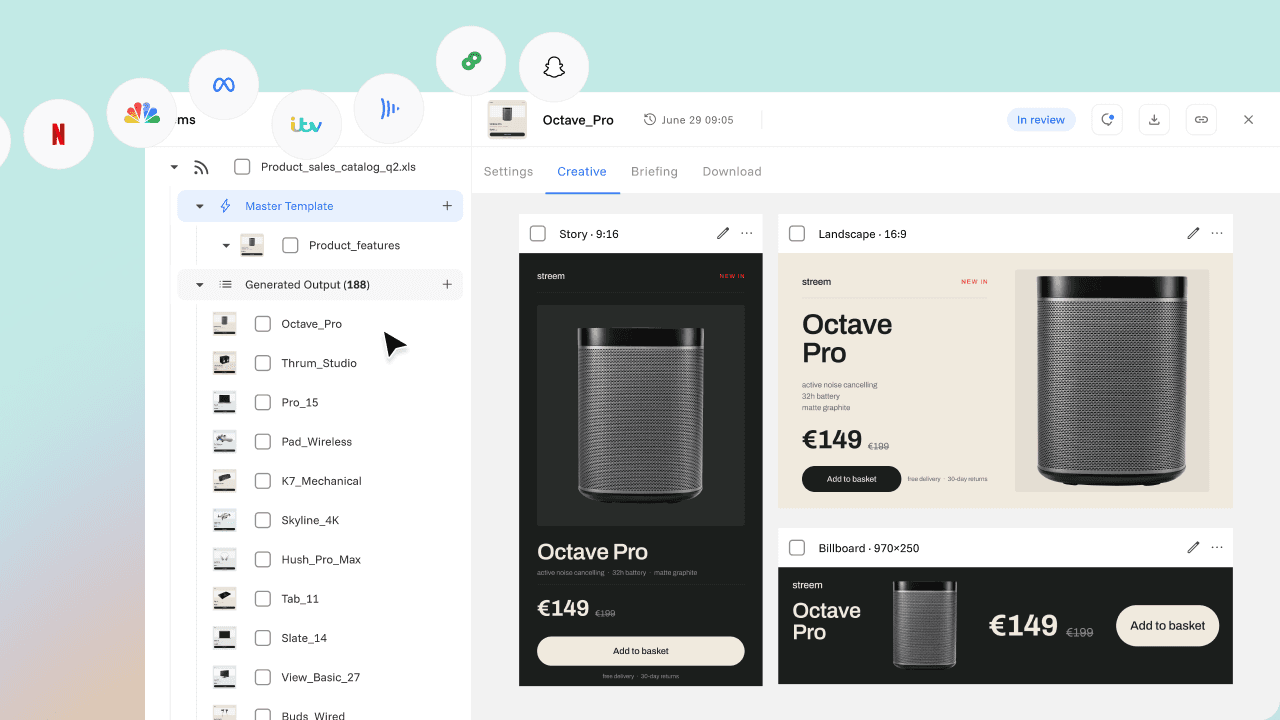
True orchestration requires an underlying infrastructure that unifies creative production, compliance validation, and media activation across both open and closed ecosystems simultaneously. It means operating seamlessly across thousands of destinations, ranging from major social platforms to hundreds of broadcast and CTV networks.
The magic happens when you normalize data across these environments in real time. When your system reads and structures performance signals across diverse channels into a single source of truth, your creative workflow becomes a continuous learning loop.
What this looks like in practice: A predictive performance signal or an audience engagement spike detected on a TikTok campaign instantly informs an automated creative adjustment, layout resize, or budget reallocation for your streaming ads on Hulu or linear broadcast networks.
Bridging the walled gardens and the open web
To survive the next wave of adtech evolution, enterprise marketing organizations must transcend the cultural and technical disconnects between design and media teams.
Advantage will no longer come from merely producing a higher volume of content. It will come from building a unified ecosystem where creative assets are generated with baked-in compliance, pre-flight tested for impact, and continuously optimized across the entire customer journey.
The walled gardens and the open web will always remain distinct environments for consumers. But for enterprise brands, your technology infrastructure must treat them as a single, harmonious canvas. That is the promise of the creative-media singularity, and it is the only way to build campaigns at machine speed while keeping humans firmly in command.
Stop bleeding ROAS to fragmented workflows.
If your creative and media teams are still operating on mismatched tools and isolated metrics, you are burning media budget. Book a brief, 15-minute strategy briefing with a Cape.io specialist to see how we can unify your campaign lifecycle from production to cross-channel activation.
ニュース
一歩先の未来へ
マーケティングと広告の最新トレンドに興味はありませんか?毎月配信のPromarketersニュースレターにぜひご登録ください。

2026/06/02
新たな現実:FIFAライツなきフットボールマーケティング
2026年のワールドカップは、この10年で最大規模の広告イベントの一つになりつつあります。しかし、サッカー熱の波に乗りたいと考えているブランドにとって、「サッカーからインスピレーションを得た表現」と「FIFAの権利侵害」の境界線は、かつてないほど曖昧になっています。非公式スポンサーによるキャンペーンから、アルコールやギャンブルのプロモーションにいたるまで、規制当局や権利保有者は厳しく目を光らせています。この夏、サッカーをテーマにしたキャンペーンを開始する前に、マーケターが知っておくべきポイントを解説します。

2026/05/08
ブラジルが投票する。Cape.ioはそれが何を意味するかをすでに知っています。
Cape.ioは4つの版にわたりブラジルの総選挙を支え、500のチャンネルと1億5500万人の有権者を管理してきました。その仕組みをご紹介します。

2026/03/18
朝食のチョコレートはもうダメ?このイースターに知っておきたい新しいLHF広告ルールへの対応策
2026年に向けて広告コンプライアンス要件が進化する中、英国の菓子ブランドは、less healthy food(LHF:健康にあまり良くない食品)の広告に関する新たな規制に直面しています。1月5日からウォーターシェッド(放送制限時間帯)規制が実施されたことに伴い、今春のイースターシーズンに掲載非承認となる事態を避けるため、広告のアシュアランス(品質保証)システムは広告の放映タイミング、掲載場所、そして製品の識別可能性(特定力)を検証する必要があります。

2026/03/16
インクルージョンの未来:Cape.ioがいかにしてメンズ・シックス・ネーションズ開催中に、ヴァージン・メディア・テレビジョンの完全バリアフリーなCM枠を実現したか
2026年3月にChannel 4のクローズドキャプション義務化が施行されるにあたり、Cape.ioはVirgin Media Television、Omnicom Media Group、そしてVoiceBoxと提携し、ギネス メンズ・シックス・ネイションズにおいて完全にアクセシブルなCM枠を提供しました。これは単なる広告規制への対応にとどまらず、ライブスポーツ放送の最高峰の舞台においてもアクセシビリティが十分に機能することを証明する瞬間となりました。

2025/11/03
静かなる革命:Channel 4のクローズドキャプション義務化が、世界の広告業界にとって画期的な一手となる理由
Channel 4 広告アクセシビリティ 2026: クローズドキャプション(字幕)の義務化と英国広告基準。

2025/09/20
Capeとともにローカルアクティベーションの課題を乗り越える
ローカルアクティベーションは、デジタルキャンペーンを身近に、そしてパーソナルに感じてもらうための鍵です。単に人々にリーチするだけでなく、彼らが住む都市、店舗、言語に合わせて、適切なメッセージを適切な人々に届けることが重要です。グローバル戦略とローカルでの実行が一致したとき、キャンペーンのパフォーマンスは向上し、予算はより効果的に機能し、ブランドはオーディエンスとより強固な関係を築くことができます。

2025/09/20
クリエイティブとメディアが同期していない — それがROIを悪化させている理由です
クリエイティブ制作とメディアバイイングが異なる時間軸で動いていると、予算が無駄になり、オーディエンスは飽きてしまいます。ここでは、その不整合がどのように、そしてなぜ静かにROIを減少させているのか、そしてそれをどのように解決すべきかを解説します。