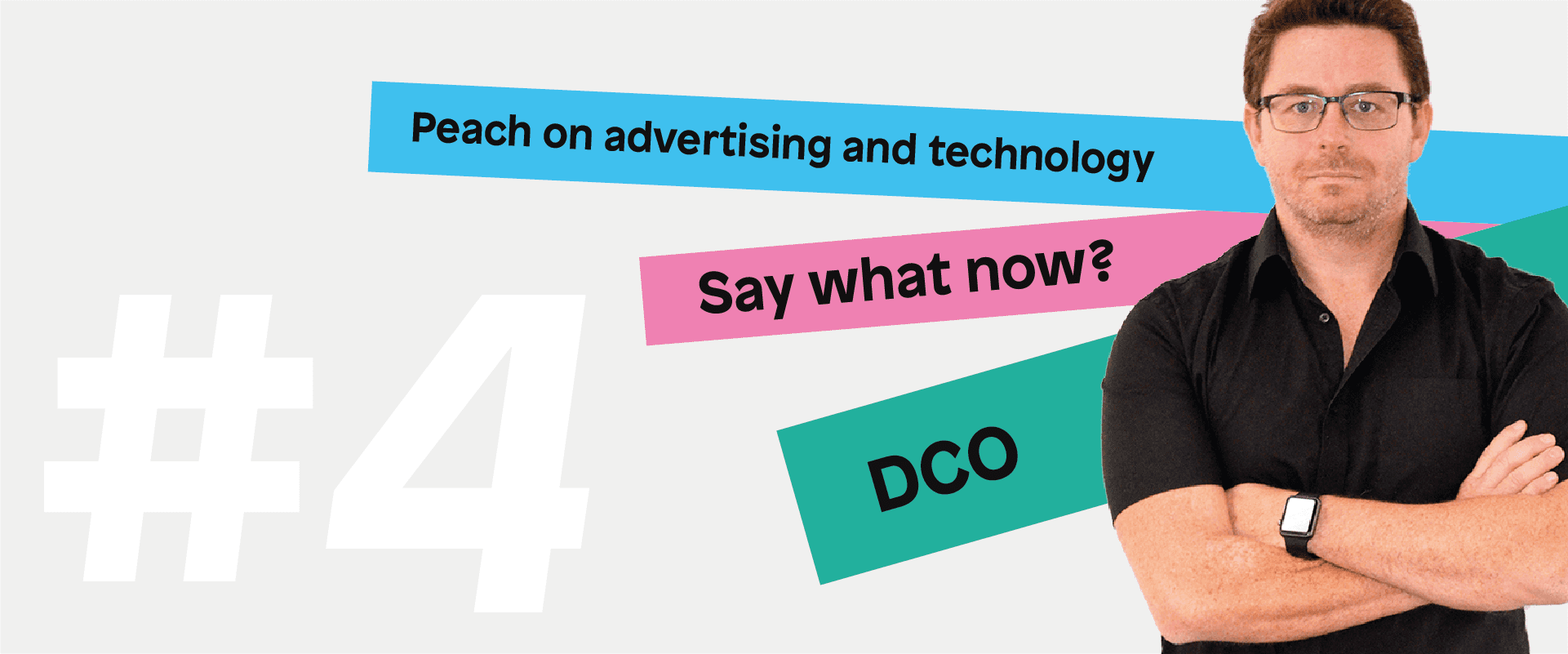
¿Qué dijiste ahora? #4: DCO: Una oportunidad para repensar la creatividad

Craig Russill-Roy explica cómo entender la optimización creativa dinámica puede darnos una ventana al futuro de la industria

Author

Cape.io

Author

Cape.io

Esta publicación de blog fue publicada originalmente en el sitio web de Peach. Descubre más sobre el cambio de marca de Peach a Cape.io.

¿Preferirías contratar a veinte personas creativas nuevas, o veinte personas nuevas de datos? Cómo respondan las agencias a esa pregunta nos dirá mucho sobre cómo se verá el mundo creativo después del Covid. 

El potencial de tensión entre creatividad y datos, por supuesto, no es nada nuevo. Durante años, los mercadólogos han estado apoyándose en datos cada vez más detallados para hablar con los consumidores de una manera que hace que sus campañas (en teoría) sean más relevantes y más efectivas. El punto ideal para todos los involucrados es cuando los datos y la creatividad trabajan de la mano, y ahí es donde entra en juego la optimización creativa dinámica (DCO). 

Conociendo el DCO

La optimización creativa dinámica es, esencialmente, el arte digital de llegar a la persona correcta con el mensaje correcto. Por ejemplo, si un chico llamado Dan está buscando hoteles en Madrid, milagrosamente encontrará que la próxima vez que esté en línea verá un anuncio de los mejores lugares turísticos que ofrece Madrid. 

Eso se debe a que hay un proceso que se lleva a cabo detrás del telón donde, en el transcurso de 100 milisegundos, el navegador web de Dan evalúa todas sus cookies y datos, así como los incontables anuncios que han sido diseñados para llenar el espacio, y ha decidido que explorar Madrid es algo que le interesará bastante a Dan en este momento. También ha usado esos mismos datos para decidir precisamente cuáles imágenes y texto serían más atractivos para Dan, y los ha incorporado en el anuncio. Eso es DCO, y es un proceso que ha definido una gran parte de la evolución de nuestra industria hacia el siglo XXI. 

Con el tiempo, el proceso también se ha vuelto mucho más sofisticado. Ahora, los creativos tienen la capacidad de jugar con activos cada vez más impresionantes y pueden usar datos para decirle a Dan dónde está el mejor lugar de paella a menos de 15 minutos del aeropuerto de Madrid Barajas. La tecnología ha avanzado mucho y todavía tiene mucho más por recorrer.

¿Una ventana al futuro?

A riesgo de convertirse en un esclavo del destino, hay mucho sucediendo en el mundo en este momento que puede decirnos cómo el DCO va a cambiar en el futuro cercano. 

Por ejemplo, hay una línea muy delgada entre la publicidad que es ‘relevante’ y la publicidad que es simplemente intrusiva. Solo porque puedas microsegmentar no significa que debas hacerlo. Utiliza la ciencia por todos los medios, pero no dejes que te deslumbre. 

De la misma manera que a nadie le agradan los vendedores telefónicos, los anuncios que son repetitivos y agresivos invariablemente se convierten en los menos efectivos. Por eso hay toda la razón para creer que los anuncios exitosos del futuro serán aquellos que unan las ventajas de la segmentación dirigida por datos y el gran trabajo creativo.

Además, también debemos tener en cuenta las formas en que el proceso DCO necesita adaptarse para mantenerse al tanto. Por ejemplo, en este momento todos nuestros anuncios están compuestos y entregados utilizando el lenguaje de ‘él’ y ‘ella’. Pero, por supuesto, en un futuro muy cercano habrá franjas de consumidores que se identificarán como ‘ellos’. Para una industria que necesita ser lo más personalmente relevante posible, eso es un cambio enorme y vital. 

"Los anuncios exitosos del futuro serán aquellos que unan las ventajas de la segmentación dirigida por datos y el gran trabajo creativo"

Un área final en la que el proceso DCO puede mostrarnos el futuro de nuestra industria es en la naturaleza de la responsabilidad. En este momento, es un cliché pero sigue siendo cierto que el mundo de la publicidad en línea es un poco como el lejano oeste. Las agencias están trabajando con informes de sus campañas que pueden estar basados en datos engañosos: por ejemplo, ¿un anuncio no fue efectivo porque era un mal anuncio, o fue porque alguien en algún lugar cometió un error en sus medidas de un píxel y el anuncio no se mostró correctamente? 

Hemos llegado a un punto donde necesitamos desesperadamente algún tipo de organismo regulador para crear estándares y establecer una ley en lo que es un poco una tierra sin ley en este momento. Para la televisión en el Reino Unido está Clearcast, mientras que en Francia está la ARPP, pero en todo el mundo hay muy poca regulación para el mundo en línea. 

Comprender el proceso de optimización creativa dinámica es instructivo. Si nuestra industria puede encontrar las respuestas a los desafíos que destaca, entonces podemos comenzar a trazar un nuevo y brillante futuro en el cual la creatividad y los datos saquen lo mejor el uno del otro.

¿Veinte nuevos creativos o veinte nuevos estrategas de datos? La mejor agencia del futuro estará contratando a diez de cada uno en este momento. 

Noticias

Mantente a la vanguardia

¿Tienes curiosidad sobre lo último en marketing y publicidad? Suscríbete a nuestro boletín mensual de Promarketers.

18 mar 2026

No more chocolate at breakfast? Navigating the new LHF ad rules this Easter

As ad compliance requirements evolve in 2026, UK confectionery brands face new restrictions on less healthy food (LHF) advertising. With the January 5 watershed now in effect, ad quality assurance systems must validate timing, placement, and product identifiability to avoid clearance failures this Easter season.

16 mar 2026

The future of inclusion: How Cape.io powered Virgin Media Television’s fully accessible ad break during the Men’s Six Nations

As Channel 4’s closed-captioning mandate came into effect in March 2026, Cape.io partnered with Virgin Media Television, Omnicom Media Group and VoiceBox to deliver a truly accessible ad break during the Guinness Men’s Six Nations. More than ad compliance, this moment proved that accessibility can operate at the highest level of live sports broadcasting.

27 feb 2026

Navigating Channel 4’s 2026 closed caption mandate

As ad compliance requirements tighten across the UK and Europe, closed captioning has evolved from an accessibility checkbox to a strategic necessity. Whether you're managing CTV campaigns or social media creative, automated ad testing for caption quality is no longer optional - it's fundamental to reaching today's fragmented, multi-screen audiences.

The advertising landscape is facing a seismic shift. By March 1, Channel 4 will become the first UK broadcaster to mandate closed captions across all advertising - including linear TV, streaming, and sponsorships.

The mandate is  a redefined standard for global inclusivity. Here is everything you need to know about the new mandate and how to stay ahead of the curve.

26 feb 2026

One platform, many realities: How creative automation platforms resolve the global vs. local tension

Scaling global marketing without losing local relevance requires more than brand guidelines and templates - it requires a creative automation platform designed for both global control and local flexibility. Most systems optimize for standardization, but scaling ad creative production across markets demands architecture that enables creative variation and adaptation by local experts without fragmenting brand governance.

Many global advertisers are chasing the same ideal: scale without losing relevance.

Consistency without uniformity.
Efficiency without bureaucracy.

It sounds simple. In practice, it’s one of the hardest tensions to resolve in modern marketing.

The global vs. local challenge isn’t new, but it’s becoming more urgent. As brands expand across markets, channels, and cultures, the question is no longer whether you should scale globally, but how you do so without erasing the nuance that makes marketing effective in the first place.

Everyone is looking for this balance. Very few get it right.

11 feb 2026

EPTVI Initiative launches Stage Two to help programmatic TV scale across Europe’s largest advertising markets

Broadcasters, streamers, agencies and ad tech companies including Google Ad Manager, Equativ, Adform, LiveRamp, The Trade Desk, FreeWheel and Cape.io begin work on practical solutions to reduce complexity and speed up adoption.

4 feb 2026

The guardrails of growth: Why creative intelligence demands compliance

Generative AI can produce thousands of creative variants, but most compliance systems are still manual, fragmented, and reactive, unable to keep pace with today’s velocity. To move fast without breaking things, the industry needs a new approach: real-time verification, programmatic enforcement, and end-to-end visibility. Embedded inside the stack, not bolted on at the end.

Noticias

Mantente a la vanguardia

¿Tienes curiosidad sobre lo último en marketing y publicidad? Suscríbete a nuestro boletín mensual de Promarketers.

18 mar 2026

No more chocolate at breakfast? Navigating the new LHF ad rules this Easter

As ad compliance requirements evolve in 2026, UK confectionery brands face new restrictions on less healthy food (LHF) advertising. With the January 5 watershed now in effect, ad quality assurance systems must validate timing, placement, and product identifiability to avoid clearance failures this Easter season.

16 mar 2026

The future of inclusion: How Cape.io powered Virgin Media Television’s fully accessible ad break during the Men’s Six Nations

As Channel 4’s closed-captioning mandate came into effect in March 2026, Cape.io partnered with Virgin Media Television, Omnicom Media Group and VoiceBox to deliver a truly accessible ad break during the Guinness Men’s Six Nations. More than ad compliance, this moment proved that accessibility can operate at the highest level of live sports broadcasting.

27 feb 2026

Navigating Channel 4’s 2026 closed caption mandate

As ad compliance requirements tighten across the UK and Europe, closed captioning has evolved from an accessibility checkbox to a strategic necessity. Whether you're managing CTV campaigns or social media creative, automated ad testing for caption quality is no longer optional - it's fundamental to reaching today's fragmented, multi-screen audiences.

The advertising landscape is facing a seismic shift. By March 1, Channel 4 will become the first UK broadcaster to mandate closed captions across all advertising - including linear TV, streaming, and sponsorships.

The mandate is  a redefined standard for global inclusivity. Here is everything you need to know about the new mandate and how to stay ahead of the curve.

26 feb 2026

One platform, many realities: How creative automation platforms resolve the global vs. local tension

Scaling global marketing without losing local relevance requires more than brand guidelines and templates - it requires a creative automation platform designed for both global control and local flexibility. Most systems optimize for standardization, but scaling ad creative production across markets demands architecture that enables creative variation and adaptation by local experts without fragmenting brand governance.

Many global advertisers are chasing the same ideal: scale without losing relevance.

Consistency without uniformity.
Efficiency without bureaucracy.

It sounds simple. In practice, it’s one of the hardest tensions to resolve in modern marketing.

The global vs. local challenge isn’t new, but it’s becoming more urgent. As brands expand across markets, channels, and cultures, the question is no longer whether you should scale globally, but how you do so without erasing the nuance that makes marketing effective in the first place.

Everyone is looking for this balance. Very few get it right.

11 feb 2026

EPTVI Initiative launches Stage Two to help programmatic TV scale across Europe’s largest advertising markets

Broadcasters, streamers, agencies and ad tech companies including Google Ad Manager, Equativ, Adform, LiveRamp, The Trade Desk, FreeWheel and Cape.io begin work on practical solutions to reduce complexity and speed up adoption.

4 feb 2026

The guardrails of growth: Why creative intelligence demands compliance

Generative AI can produce thousands of creative variants, but most compliance systems are still manual, fragmented, and reactive, unable to keep pace with today’s velocity. To move fast without breaking things, the industry needs a new approach: real-time verification, programmatic enforcement, and end-to-end visibility. Embedded inside the stack, not bolted on at the end.

Noticias

Mantente a la vanguardia

¿Tienes curiosidad sobre lo último en marketing y publicidad? Suscríbete a nuestro boletín mensual de Promarketers.

18 mar 2026

No more chocolate at breakfast? Navigating the new LHF ad rules this Easter

As ad compliance requirements evolve in 2026, UK confectionery brands face new restrictions on less healthy food (LHF) advertising. With the January 5 watershed now in effect, ad quality assurance systems must validate timing, placement, and product identifiability to avoid clearance failures this Easter season.

16 mar 2026

The future of inclusion: How Cape.io powered Virgin Media Television’s fully accessible ad break during the Men’s Six Nations

As Channel 4’s closed-captioning mandate came into effect in March 2026, Cape.io partnered with Virgin Media Television, Omnicom Media Group and VoiceBox to deliver a truly accessible ad break during the Guinness Men’s Six Nations. More than ad compliance, this moment proved that accessibility can operate at the highest level of live sports broadcasting.

27 feb 2026

Navigating Channel 4’s 2026 closed caption mandate

As ad compliance requirements tighten across the UK and Europe, closed captioning has evolved from an accessibility checkbox to a strategic necessity. Whether you're managing CTV campaigns or social media creative, automated ad testing for caption quality is no longer optional - it's fundamental to reaching today's fragmented, multi-screen audiences.

The advertising landscape is facing a seismic shift. By March 1, Channel 4 will become the first UK broadcaster to mandate closed captions across all advertising - including linear TV, streaming, and sponsorships.

The mandate is  a redefined standard for global inclusivity. Here is everything you need to know about the new mandate and how to stay ahead of the curve.

26 feb 2026

One platform, many realities: How creative automation platforms resolve the global vs. local tension

Scaling global marketing without losing local relevance requires more than brand guidelines and templates - it requires a creative automation platform designed for both global control and local flexibility. Most systems optimize for standardization, but scaling ad creative production across markets demands architecture that enables creative variation and adaptation by local experts without fragmenting brand governance.

Many global advertisers are chasing the same ideal: scale without losing relevance.

Consistency without uniformity.
Efficiency without bureaucracy.

It sounds simple. In practice, it’s one of the hardest tensions to resolve in modern marketing.

The global vs. local challenge isn’t new, but it’s becoming more urgent. As brands expand across markets, channels, and cultures, the question is no longer whether you should scale globally, but how you do so without erasing the nuance that makes marketing effective in the first place.

Everyone is looking for this balance. Very few get it right.

11 feb 2026

EPTVI Initiative launches Stage Two to help programmatic TV scale across Europe’s largest advertising markets

Broadcasters, streamers, agencies and ad tech companies including Google Ad Manager, Equativ, Adform, LiveRamp, The Trade Desk, FreeWheel and Cape.io begin work on practical solutions to reduce complexity and speed up adoption.

4 feb 2026

The guardrails of growth: Why creative intelligence demands compliance

Generative AI can produce thousands of creative variants, but most compliance systems are still manual, fragmented, and reactive, unable to keep pace with today’s velocity. To move fast without breaking things, the industry needs a new approach: real-time verification, programmatic enforcement, and end-to-end visibility. Embedded inside the stack, not bolted on at the end.

Ponte en contacto

Te mostraremos lo que Cape.io puede hacer.

Automatización de Campañas Inteligentes

Cape.io conecta a tu equipo, DAM, servidores de anuncios, DSP, herramientas y más, para que no necesites desmantelar y reemplazar.

© 2025 Cape.io. Todos los derechos reservados

Spanish

Ponte en contacto

Te mostraremos lo que Cape.io puede hacer.

Automatización de Campañas Inteligentes

Cape.io conecta a tu equipo, DAM, servidores de anuncios, DSP, herramientas y más, para que no necesites desmantelar y reemplazar.

© 2025 Cape.io. Todos los derechos reservados

Spanish

Ponte en contacto

Te mostraremos lo que Cape.io puede hacer.

Automatización de Campañas Inteligentes

Cape.io conecta a tu equipo, DAM, servidores de anuncios, DSP, herramientas y más, para que no necesites desmantelar y reemplazar.

© 2025 Cape.io. Todos los derechos reservados

Spanish