20 oct. 2019

Moins de temps ? Plus d'écrans. Comment s'adapter à l'ère du contenu de masse

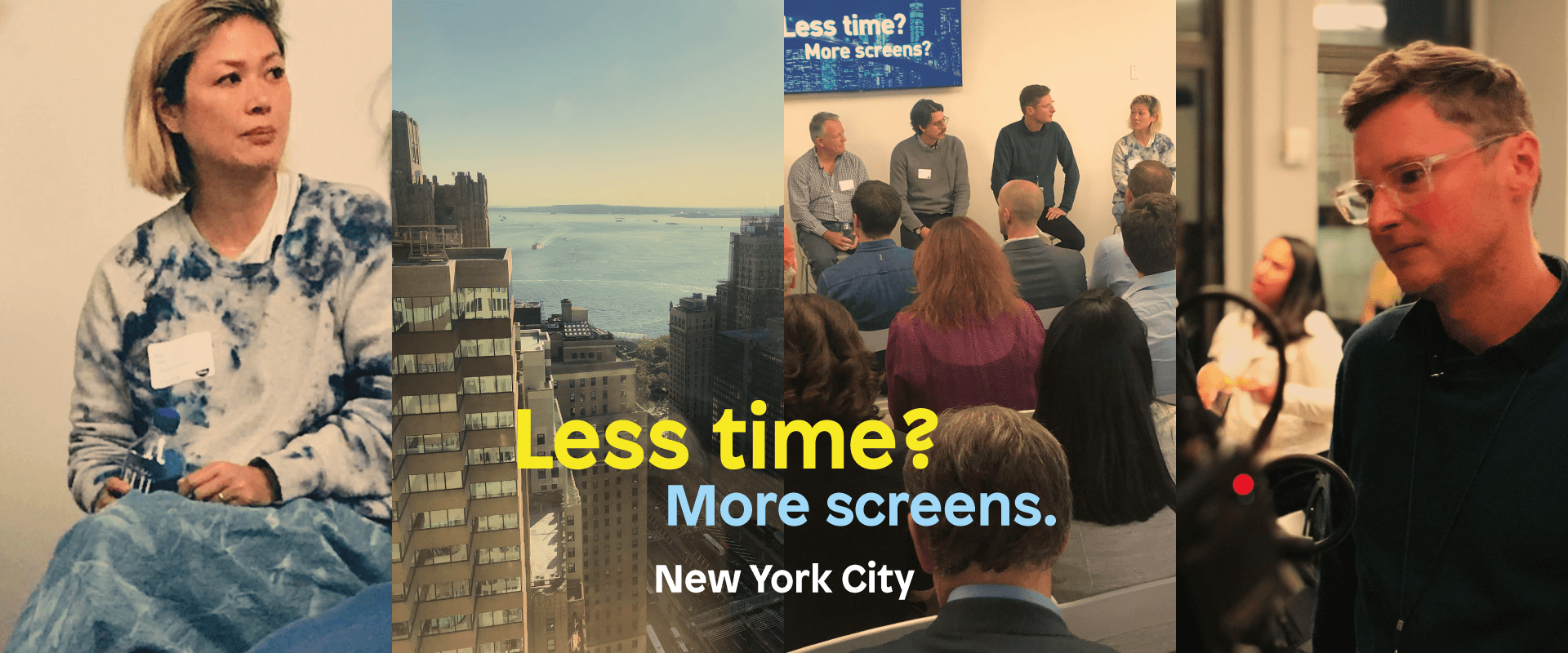
Lors de notre événement à New York avec Comcast Technology Solutions, Instagram, Droga5, Publicis, Framestore et MCA ont donné leur avis sur ce que cela signifie pour l'industrie lorsque les écrans sont en augmentation et que le contenu est à son niveau le plus élevé.

Author

Cape.io

Author

Cape.io

Ceci a été initialement publié sur le site Web de Peach. En savoir plus sur le changement de marque de Peach à Cape.io.

En 2019, plus de données et plus de contenu inondent la culture à un rythme alarmant mais avec une opportunité incroyable pour les annonceurs et les industries créatives. Les changements récents dans les comportements de consommation de contenu (en raison de l'avancement rapide de la technologie) ont provoqué des bouleversements dans l'industrie publicitaire. Les créatifs et les agences doivent évoluer plus rapidement que jamais pour rester au sommet de ce nouveau territoire inexploré, une grande partie se trouvant derrière un écran. Des compétences qui n'ont jamais existé auparavant sont très demandées tandis que d'autres sont automatisées.

Pour approfondir les complexités de notre adaptation dans ce monde multi-plateformes riche en contenu, Peach et Comcast Technology Solutions ont invité Kay Hsu, directrice mondiale d'Instagram Creative Shop ; Andy Bird, CCO de Publicis North America ; Jesse Brihn, directeur de la production cinématographique chez Droga5 ; Charles Howell, MD chez Framestore ; et Pat Murphy, fondateur de MCA, à une table ronde animée par le fondateur et PDG de Little Black Book, Matt Cooper.

Ici, Sunna Naseer de LBB décompose les points clés de cet événement formateur à New York...

Ciblage des Données Digitales

L'accès aux données n'a jamais été aussi facile - jusqu'aux statistiques individuelles des consommateurs. Les Marques et entreprises ont désormais la capacité de créer des campagnes hautement personnalisées et ciblées. Matt Cooper de LBB demande au panel : « Comment l'industrie gère-t-elle ce changement d'approche ? »

« Les données sont là pour rester que nous le voulions ou non », déclare le fondateur de MCA, Pat Murphy. « Si vous avez une excellente idée créative, les données peuvent la rendre encore plus efficace. Mettez les deux ensemble, je pense que c'est énorme. »

Kay Hsu, directrice mondiale d'Instagram Creative Shop, a éclairé cette question : « Lorsque l'on observe comment les perturbateurs créent du contenu, c’est complètement différent de la méthode traditionnelle d'une agence. Ils embauchent différemment, ils embauchent des jeunes, ils utilisent leurs téléphones, ils sont moins précieux. Les plus grandes Marques peuvent apprendre beaucoup de certaines de ces Marques perturbatrices. La formation dans l'industrie est encore assez traditionnelle, donc lorsque les étudiants en sortent, ils sont moins préparés pour répondre aux besoins de contenu les plus récents. »

Andy Bird, directeur de la création chez Publicis North America, est d'accord : « Les Créatifs doivent apprendre différentes disciplines et compétences pour s'adapter au changement. La façon dont nous livrons le travail et les attentes des clients ont évolué. La stratégie créative sort parfois de nulle part, mais les clients aiment les faits, donc lorsqu'ils voient une idée vraiment créative qui découle des données, ils adorent ça. Le mot données effrayait les Créatifs il y a quelques années, mais je ne pense pas que ce soit le cas désormais. »

Automatisation et Créativité : Peuvent-Elles Coexister ?

« J'espère que oui, car c'est là où nous allons », dit Andy. « Sinon, nous sommes un peu fichus ! Cela dépend de la quantité de matériel que vous avez à automatiser et vous êtes très limité en raison du coût. Il doit y avoir une meilleure façon d'introduire l'automatisation dans le système. L'artisanat est important aussi. »

Jesse Brihn, directeur de la production cinématographique chez Droga5 ajoute : « Il y a certaines directives que vous pouvez suivre pour inciter quelqu'un à cliquer ou à utiliser quelque chose. Vous créez un processus ou une sortie automatiques, mais vous avez aussi des gens incroyablement intelligents qui ont construit leur carrière sur l'art de rendre les choses automatiques. Instagram a une plateforme entière construite autour des meilleures pratiques et directives d'utilisation, mais vous ne voudriez jamais que quelqu'un regurgite le même type de chose dans ce contexte ou qu'un bot le fasse. »

Pat résume : « À la fin de la journée, si vous n'avez pas un créatif exceptionnel, vous n'avez rien à automatiser. »

Budgets Réduits

Dans toute l'industrie, les budgets sont réduits, mais le travail doit toujours être tout aussi percutant. Cela a poussé à plus de créativité pour produire la même qualité de travail avec moins.

« La meilleure façon de faire cela est de pré-planifier. Nous constatons le plus de succès si l'agence media et l'agence créative travaillent en symbiose pour planifier quels actifs sont nécessaires avant de se lancer dans tout processus de production », dit Pat. « Notre travail n'est pas la réduction ou le contrôle des coûts. Notre mission est de prendre un budget et d'obtenir le meilleur retour sur investissement. Si nous travaillons bien avec les agences, alors vous obtenez la meilleure créativité. »

Jesse souligne : « Il ne s'agit pas nécessairement d'économiser autant d'argent que possible car ce sera toujours le cas. Il s'agit de saisir les opportunités pour le positionner correctement et de manière adéquate. Quelque chose qui peut être perçu comme une terrible publicité ou un terrible contenu peut ne pas réellement être une mauvaise pièce de travail, cela peut simplement être mal ciblé. Si vous utilisez les données pour aider à cibler les marchés et plateformes, vous pouvez faire des choses bien faites même avec un budget. »

Lisez l'article complet sur LBB ou regardez la vidéo de l'intégralité de l'événement ici

Nouvelles

Anticipez les tendances

Vous êtes curieux des dernières tendances en marketing et publicité ? Abonnez-vous à notre newsletter mensuelle Promarketers.

18 mars 2026

No more chocolate at breakfast? Navigating the new LHF ad rules this Easter

As ad compliance requirements evolve in 2026, UK confectionery brands face new restrictions on less healthy food (LHF) advertising. With the January 5 watershed now in effect, ad quality assurance systems must validate timing, placement, and product identifiability to avoid clearance failures this Easter season.

16 mars 2026

The future of inclusion: How Cape.io powered Virgin Media Television’s fully accessible ad break during the Men’s Six Nations

As Channel 4’s closed-captioning mandate came into effect in March 2026, Cape.io partnered with Virgin Media Television, Omnicom Media Group and VoiceBox to deliver a truly accessible ad break during the Guinness Men’s Six Nations. More than ad compliance, this moment proved that accessibility can operate at the highest level of live sports broadcasting.

27 févr. 2026

Navigating Channel 4’s 2026 closed caption mandate

As ad compliance requirements tighten across the UK and Europe, closed captioning has evolved from an accessibility checkbox to a strategic necessity. Whether you're managing CTV campaigns or social media creative, automated ad testing for caption quality is no longer optional - it's fundamental to reaching today's fragmented, multi-screen audiences.

The advertising landscape is facing a seismic shift. By March 1, Channel 4 will become the first UK broadcaster to mandate closed captions across all advertising - including linear TV, streaming, and sponsorships.

The mandate is  a redefined standard for global inclusivity. Here is everything you need to know about the new mandate and how to stay ahead of the curve.

26 févr. 2026

One platform, many realities: How creative automation platforms resolve the global vs. local tension

Scaling global marketing without losing local relevance requires more than brand guidelines and templates - it requires a creative automation platform designed for both global control and local flexibility. Most systems optimize for standardization, but scaling ad creative production across markets demands architecture that enables creative variation and adaptation by local experts without fragmenting brand governance.

Many global advertisers are chasing the same ideal: scale without losing relevance.

Consistency without uniformity.
Efficiency without bureaucracy.

It sounds simple. In practice, it’s one of the hardest tensions to resolve in modern marketing.

The global vs. local challenge isn’t new, but it’s becoming more urgent. As brands expand across markets, channels, and cultures, the question is no longer whether you should scale globally, but how you do so without erasing the nuance that makes marketing effective in the first place.

Everyone is looking for this balance. Very few get it right.

11 févr. 2026

EPTVI Initiative launches Stage Two to help programmatic TV scale across Europe’s largest advertising markets

Broadcasters, streamers, agencies and ad tech companies including Google Ad Manager, Equativ, Adform, LiveRamp, The Trade Desk, FreeWheel and Cape.io begin work on practical solutions to reduce complexity and speed up adoption.

4 févr. 2026

The guardrails of growth: Why creative intelligence demands compliance

Generative AI can produce thousands of creative variants, but most compliance systems are still manual, fragmented, and reactive, unable to keep pace with today’s velocity. To move fast without breaking things, the industry needs a new approach: real-time verification, programmatic enforcement, and end-to-end visibility. Embedded inside the stack, not bolted on at the end.

Nouvelles

Anticipez les tendances

Vous êtes curieux des dernières tendances en marketing et publicité ? Abonnez-vous à notre newsletter mensuelle Promarketers.

18 mars 2026

No more chocolate at breakfast? Navigating the new LHF ad rules this Easter

As ad compliance requirements evolve in 2026, UK confectionery brands face new restrictions on less healthy food (LHF) advertising. With the January 5 watershed now in effect, ad quality assurance systems must validate timing, placement, and product identifiability to avoid clearance failures this Easter season.

16 mars 2026

The future of inclusion: How Cape.io powered Virgin Media Television’s fully accessible ad break during the Men’s Six Nations

As Channel 4’s closed-captioning mandate came into effect in March 2026, Cape.io partnered with Virgin Media Television, Omnicom Media Group and VoiceBox to deliver a truly accessible ad break during the Guinness Men’s Six Nations. More than ad compliance, this moment proved that accessibility can operate at the highest level of live sports broadcasting.

27 févr. 2026

Navigating Channel 4’s 2026 closed caption mandate

As ad compliance requirements tighten across the UK and Europe, closed captioning has evolved from an accessibility checkbox to a strategic necessity. Whether you're managing CTV campaigns or social media creative, automated ad testing for caption quality is no longer optional - it's fundamental to reaching today's fragmented, multi-screen audiences.

The advertising landscape is facing a seismic shift. By March 1, Channel 4 will become the first UK broadcaster to mandate closed captions across all advertising - including linear TV, streaming, and sponsorships.

The mandate is  a redefined standard for global inclusivity. Here is everything you need to know about the new mandate and how to stay ahead of the curve.

26 févr. 2026

One platform, many realities: How creative automation platforms resolve the global vs. local tension

Scaling global marketing without losing local relevance requires more than brand guidelines and templates - it requires a creative automation platform designed for both global control and local flexibility. Most systems optimize for standardization, but scaling ad creative production across markets demands architecture that enables creative variation and adaptation by local experts without fragmenting brand governance.

Many global advertisers are chasing the same ideal: scale without losing relevance.

Consistency without uniformity.
Efficiency without bureaucracy.

It sounds simple. In practice, it’s one of the hardest tensions to resolve in modern marketing.

The global vs. local challenge isn’t new, but it’s becoming more urgent. As brands expand across markets, channels, and cultures, the question is no longer whether you should scale globally, but how you do so without erasing the nuance that makes marketing effective in the first place.

Everyone is looking for this balance. Very few get it right.

11 févr. 2026

EPTVI Initiative launches Stage Two to help programmatic TV scale across Europe’s largest advertising markets

Broadcasters, streamers, agencies and ad tech companies including Google Ad Manager, Equativ, Adform, LiveRamp, The Trade Desk, FreeWheel and Cape.io begin work on practical solutions to reduce complexity and speed up adoption.

4 févr. 2026

The guardrails of growth: Why creative intelligence demands compliance

Generative AI can produce thousands of creative variants, but most compliance systems are still manual, fragmented, and reactive, unable to keep pace with today’s velocity. To move fast without breaking things, the industry needs a new approach: real-time verification, programmatic enforcement, and end-to-end visibility. Embedded inside the stack, not bolted on at the end.

Nouvelles

Anticipez les tendances

Vous êtes curieux des dernières tendances en marketing et publicité ? Abonnez-vous à notre newsletter mensuelle Promarketers.

18 mars 2026

No more chocolate at breakfast? Navigating the new LHF ad rules this Easter

As ad compliance requirements evolve in 2026, UK confectionery brands face new restrictions on less healthy food (LHF) advertising. With the January 5 watershed now in effect, ad quality assurance systems must validate timing, placement, and product identifiability to avoid clearance failures this Easter season.

16 mars 2026

The future of inclusion: How Cape.io powered Virgin Media Television’s fully accessible ad break during the Men’s Six Nations

As Channel 4’s closed-captioning mandate came into effect in March 2026, Cape.io partnered with Virgin Media Television, Omnicom Media Group and VoiceBox to deliver a truly accessible ad break during the Guinness Men’s Six Nations. More than ad compliance, this moment proved that accessibility can operate at the highest level of live sports broadcasting.

27 févr. 2026

Navigating Channel 4’s 2026 closed caption mandate

As ad compliance requirements tighten across the UK and Europe, closed captioning has evolved from an accessibility checkbox to a strategic necessity. Whether you're managing CTV campaigns or social media creative, automated ad testing for caption quality is no longer optional - it's fundamental to reaching today's fragmented, multi-screen audiences.

The advertising landscape is facing a seismic shift. By March 1, Channel 4 will become the first UK broadcaster to mandate closed captions across all advertising - including linear TV, streaming, and sponsorships.

The mandate is  a redefined standard for global inclusivity. Here is everything you need to know about the new mandate and how to stay ahead of the curve.

26 févr. 2026

One platform, many realities: How creative automation platforms resolve the global vs. local tension

Scaling global marketing without losing local relevance requires more than brand guidelines and templates - it requires a creative automation platform designed for both global control and local flexibility. Most systems optimize for standardization, but scaling ad creative production across markets demands architecture that enables creative variation and adaptation by local experts without fragmenting brand governance.

Many global advertisers are chasing the same ideal: scale without losing relevance.

Consistency without uniformity.
Efficiency without bureaucracy.

It sounds simple. In practice, it’s one of the hardest tensions to resolve in modern marketing.

The global vs. local challenge isn’t new, but it’s becoming more urgent. As brands expand across markets, channels, and cultures, the question is no longer whether you should scale globally, but how you do so without erasing the nuance that makes marketing effective in the first place.

Everyone is looking for this balance. Very few get it right.

11 févr. 2026

EPTVI Initiative launches Stage Two to help programmatic TV scale across Europe’s largest advertising markets

Broadcasters, streamers, agencies and ad tech companies including Google Ad Manager, Equativ, Adform, LiveRamp, The Trade Desk, FreeWheel and Cape.io begin work on practical solutions to reduce complexity and speed up adoption.

4 févr. 2026

The guardrails of growth: Why creative intelligence demands compliance

Generative AI can produce thousands of creative variants, but most compliance systems are still manual, fragmented, and reactive, unable to keep pace with today’s velocity. To move fast without breaking things, the industry needs a new approach: real-time verification, programmatic enforcement, and end-to-end visibility. Embedded inside the stack, not bolted on at the end.

Prendre contact

Découvrez tout ce que Cape.io peut faire pour vous

Automatisation Intelligente des Campagnes

Cape.io connecte votre équipe, votre DAM, vos ad servers, vos DSP et vos autres outils, sans qu’il soit nécessaire de tout remplacer

© 2025 Cape.io. Tous droits réservés

Français

Prendre contact

Découvrez tout ce que Cape.io peut faire pour vous

Automatisation Intelligente des Campagnes

Cape.io connecte votre équipe, votre DAM, vos ad servers, vos DSP et vos autres outils, sans qu’il soit nécessaire de tout remplacer

© 2025 Cape.io. Tous droits réservés

Français

Prendre contact

Découvrez tout ce que Cape.io peut faire pour vous

Automatisation Intelligente des Campagnes

Cape.io connecte votre équipe, votre DAM, vos ad servers, vos DSP et vos autres outils, sans qu’il soit nécessaire de tout remplacer

© 2025 Cape.io. Tous droits réservés

Français