You don't have an AI problem. You have a trust problem.
Every marketer is being sold intelligence. But intelligence without accountability is just noise at scale. Here's what the real question actually is.
类别

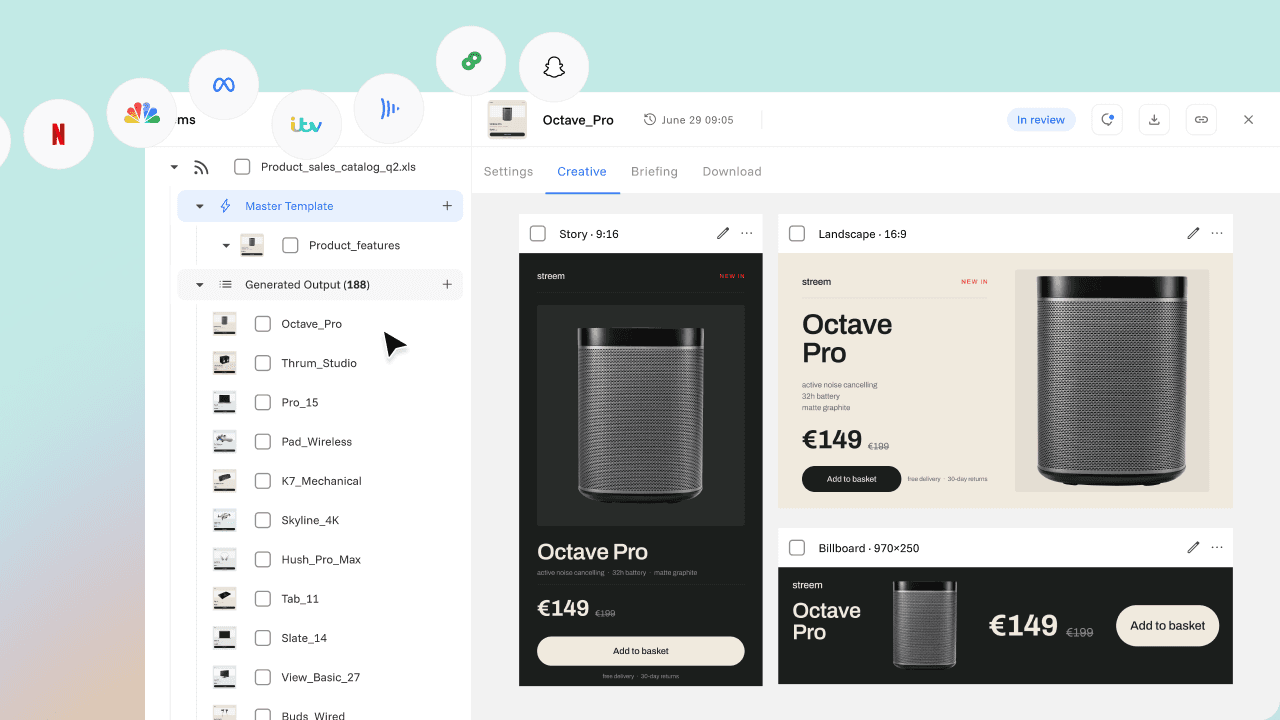
Your inbox has been full of it for two years now. AI-powered this. Intelligent automation that. Every platform promising to think for you, scale for you, decide for you. And yet here you are still manually checking feeds at 11pm before a launch, still running the post-mortem three weeks after the campaign ended, still wondering why the version that went live wasn't the version that was approved. The tools got smarter. The anxiety didn't go away. That's not a coincidence. It's a signal.
Can automation actually be trusted?
The question every CMO, creative director, and performance lead is quietly asking isn't "how do I automate more?" It is: "Can automated campaign execution actually be trusted to run at scale without breaking?"
Right now, the honest answer across the market is no. Feeds drop mid-flight, compliance gaps surface after spend, and systems can't learn from what just happened. That is the category's trust problem—and it's the exact problem we are built to solve. We’ve made trust the product, not a feature. It is the absolute precondition for Intelligent Campaign Automation.
The real cost of getting it wrong
Think about what actually breaks. It's rarely the big, visible failure. It's the feed that quietly goes empty for six hours on a peak trading day. It's the creative that runs in a market it was never cleared for. It's the version of the asset that was 98% correct, and that 2% costs you the client relationship.
The budget hit is real. The brand damage is real. But the deeper cost is what it does to the people doing the work. When you can't trust your systems, you compensate with human vigilance. You add checklist upon checklist. You duplicate effort. You hire for anxiety management rather than creative thinking.
The hidden tax
The real cost of non-compliance isn't just the fine or the pull-down. It's the culture that develops around the fear of it—the layers of manual review, the approval paralysis, the creative risk-aversion that slowly hollows out the work. That's the tax most organizations are paying without ever seeing it on a line item.
What intelligence actually requires
Here's the thing about claiming to be intelligent: you have to earn it. And you earn it on four fronts:
01: It runs campaigns more efficiently
Unlocking speed and scale that creates genuine capacity for your team, not automation that just creates a new category of QA work.
02: It catches compliance issues before they air
Baking pre-testing, feed integrity, and brand governance directly into the workflow, rather than relying on dashboards that tell you what went wrong after the budget is spent.
03: It closes the feedback loop
Delivering instant signals, not post-mortems. Campaign intelligence that responds in the moment.
04: It compounds decisions on your own history
Optimization built on your patterns, your audience, and your performance story, so every campaign gets sharper the longer you use the system.
Most platforms deliver one or two of these. They call it intelligence. It isn't. Intelligence is what happens when all four work together and when the whole thing sits inside a culture of trust that makes people want to use it rather than route around it.
Why our intelligence is real, not theoretical
Why can we make this real when others can't? Our TV broadcast heritage (linear + IPTV). We have lived through compliance failures, strict regulations, and broken feeds at global scale for nearly three decades. We know exactly what an empty campaign does to a brand and a budget. That history is our structural moat. It is what makes our intelligence real, battle-tested, and built for the enterprise.
The person you're building for has changed
There's a role emerging that doesn't have a clean job title yet. They're the creative director who can read a performance report without needing it translated. The media planner who has opinions about copy. The performance lead who genuinely cares about the quality of the creative they're optimizing.
Call them the creative engineer. The creative scientist. Whatever the title ends up being, they're already in your organization, and they're frustrated. They're frustrated because the tools they use were built for specialists in separate lanes. The creative platform doesn't talk to the activation layer. The compliance check happens after the build. The performance data lives somewhere the creative team never looks. The convergence is real. The infrastructure for it mostly isn't yet.
Two ideas worth taking seriously
There are two concepts that the industry should be building toward. Neither exists properly yet, but both point at something important.
A number that actually means something: CAPE.IO SCORE™
Imagine an NPS-style measure of campaign intelligence—a single score that captures compliance status, brand safety, performance readiness, feed integrity, and optimization maturity. Not a traffic-light dashboard. A number that compounds over time, that your team can rally around, that a client can understand in a single glance. The closest analogy in marketing is the brand health tracker, except this one would update in near real-time and tell you what to do, not just how you're doing.
The self-compounding campaign intelligence loop
Create & validate ➔ Activate across destinations ➔ Capture performance signals ➔ Sharpen the model.
The platforms that will win in five years aren't the ones with the smartest algorithm. They're the ones where every campaign makes the next campaign better. Where your historical data is an asset, not a graveyard of PDFs in a shared drive. Where adding a new destination or integration doesn't mean starting from scratch, but unlocking a new layer of cross-channel optimization that compounds on everything you've already built. That's not a feature. That's a different business model for intelligence entirely.
The seam between creation and optimization
The category that matters isn't just creative automation, and it isn't just media optimization. We sit right in the seam between them—and that is exactly the point. Risk mitigation and intelligent creative decisioning are two sides of the same coin. That isn't a positioning problem; that is our wedge.
Risk mitigation and creative quality aren't opposites. A compliant, brand-safe, pre-tested piece of creative isn't the watered-down version. It's the confident version. The one that runs without someone checking their phone at midnight. The one that a client signs off on because the process that produced it gives them reason to trust it.
That's the shift. From automation as a production tool to intelligence as a competitive advantage. The difference isn't the technology. It's the trust infrastructure underneath it and whether the platform you're using has earned the right to call itself intelligent.
The question isn't whether to use campaign intelligence. It's whether yours has earned your trust.
新闻
趋势前沿
想了解市场营销和广告领域的最新动态吗?欢迎订阅我们的 Promarketers 月度简报。

2026年6月24日
Why creative infrastructure is the real bottleneck in media orchestration
The disconnect between creative and media in programmatic advertising.

2026年6月2日
新现实:没有 FIFA 权益的足球营销
2026年世界杯(World Cup)正逐渐成为这十年中最大的广告契机之一。但对于希望借势足球热潮 obst 品牌而言,“足球灵感”与“侵犯FIFA权益”之间的界限从未如此模糊。从非官方赞助商的营销活动,到酒精和博彩促销,监管机构和权利持有人都在密切关注。在今年夏天推出足球主题营销活动之前,营销人员需要了解以下几点。

2026年5月26日
企业实际上是如何采用 agentic AI 的
向 agentic AI 的转变并不像大多数厂商描述的那样。企业并不会在某个瞬间突然抛弃他们的 AI wrappers 并全力投入到完整的 agent 编排中。相反,他们正在逐步过渡,在一个团队中测试 frameworks,同时保持另一个团队的生产系统稳定。

2026年5月26日
监管环境下的 Real-time ads
深入了解美国 gambling & sports betting 广告面临的真实挑战

2026年5月8日
巴西 votes。Cape.io 已经知道了这意味着什么意思。
Cape.io 已经为巴西的四届大选提供了技术支持,管理着 500 个频道和 1.55 亿选民。以下是我们的具体做法。

2026年4月23日
Agentic AI、AI wrappers 还是 custom AI:如何选择你的路径
你即将在一项 AI 计划上投入 50 万美元。现在有 3 个方案摆在桌面上,它们将带你走向截然不同的结局。选错了,18 个月后你就得推倒重来;选对了,你将拥有一个可扩展、维护成本更低且能真正兑现高管承诺的系统。这三个选择分别是:封装现有的 AI models、从头构建定制化的 AI solutions,或者采用 agentic 路线。大多数团队在深陷错误的选择之前,根本无法看清真正的权衡利弊。

2026年3月30日
在广告中使 AI 落地运营:为什么它必须是嵌入式的,而非外挂式的
在广告中落地 AI,绝不仅仅是往你的现有技术栈中叠加一个新的工具。它是要将智能深度嵌入到主导创意生产、合规审核以及内容交付的系统里,从而在不增加运营摩擦的情况下实现规模化自动化运作。

2026年3月18日
早餐不能再吃巧克力了?在这个复活节解读全新 LHF 广告规则
随着2026年广告合规要求的演变,英国糖果品牌面临对不健康食品(LHF)广告的新限制。随着1月5日的分水岭政策正式生效,广告质量保证系统必须验证播放时间、投放位置和产品可识别性,以避免在今年复活节期间无法通过 clearance。

2026年3月16日
融合的未来:Cape.io 如何助力维珍媒体电视台在六国橄榄球男子锦标赛期间,打造完全无障碍的广告时段
随着 Channel 4 的闭路字幕指令于 2026 年 3 月生效,Cape.io 与 Virgin Media Television、Omnicom Media Group 以及 VoiceBox 展开合作,在 Guinness 六国男子橄榄球锦标赛期间提供了一个实现真正无障碍的广告时段。这不仅仅是广告合规,这一时刻证明了无障碍技术可以在最高水平的体育赛事直播中运行。

2026年2月4日
增长的护栏:为什么创意智能需要 compliance
Generative AI 可以产生数以千计的创意变体,但大多数合规系统仍然是手动的、零散的且被动的,无法跟上当今的速度。为了在快速推进的同时不出现差错,行业需要一种全新的方法:实时验证、程式化执行(programmatic enforcement)以及端到端的可视性。这一切应该嵌入在技术栈内部,而不是在最后才强加进去。