A picture's worth a thousand clicks: how to use visual analysis for better campaigns

Optimizing ads can feel like a never-ending guessing game. With Visual Analysis AI, Cape brings data-backed clarity to your creative decisions, improving ad effectiveness before your campaign goes live.

Category

Smarter ads start with visual analysis AI: how Cape optimizes creative before you even launch

Optimizing your ads can feel like a never-ending guessing game. What elements actually drive performance? Which creative tweaks truly make a difference?

With Visual Analysis AI, Cape brings data-backed clarity to your creative decisions; empowering you to improve ad effectiveness before your campaign even goes live.

What Is Visual Analysis AI?

Visual Analysis AI uses computer vision to evaluate ad creatives the way a human would - but faster, at scale, and with precision. It analyzes visuals based on proven design principles and performance insights to help predict which ads are more likely to succeed.

As digital marketing becomes increasingly visual, Cape makes it easy to optimize the creative process early; saving time, reducing revisions, and improving results.

How Cape Uses Visual Analysis to Improve Ad Performance

Cape’s platform leverages Visual Analysis AI to help you:

  • Evaluate creatives before publishing
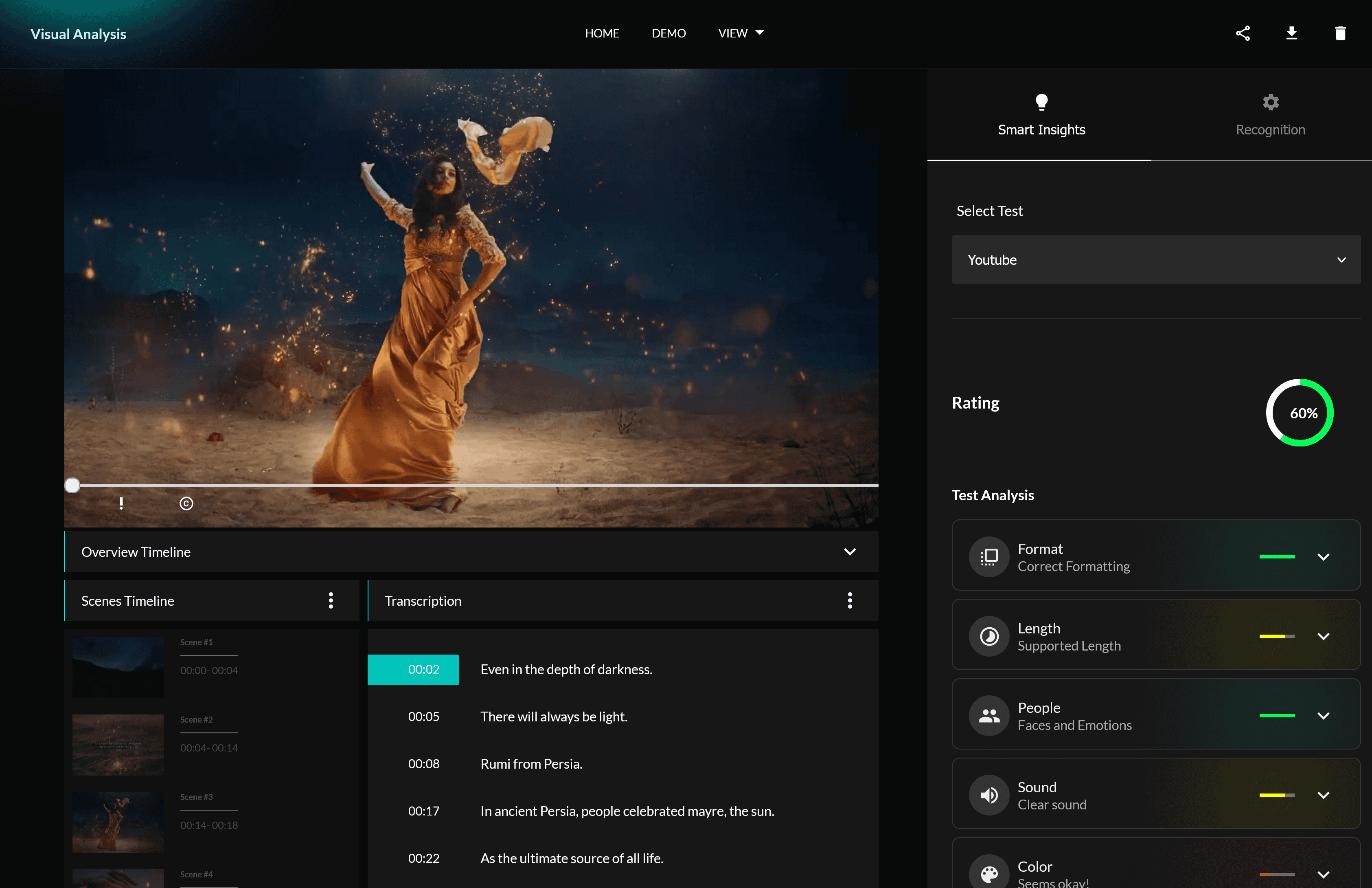
    Gain predictive insights on layout, text balance, logo placement, brightness, contrast, and more (before the ad hits the market).

  • Give real-time feedback during design
    Support your creative team with instant, actionable suggestions while they’re building the ad - not after it’s already running.

  • Automate visual optimization at scale
    Using tools like Google Vision API and advanced JavaScript libraries, Cape scores ads against best-practice design benchmarks to flag areas for improvement.

What Cape’s Visual AI Measures

Cape’s system evaluates a wide range of creative components, including:

  • Color composition and contrast

  • Brightness and image clarity

  • Rule of thirds and overall layout

  • Logo placement and size

  • Text visibility, length, and hierarchy

  • Facial presence and emotional cues

  • Visual balance and clutter

These criteria are grounded in research that connects visual design to real ad performance, turning subjective creative decisions into objective, data-informed choices.
What’s Next: Self-Learning Creative Optimization

Cape’s current system predicts ad quality based on visual principles and performance data. Our next step is building a self-learning model that links these predictions directly to campaign outcomes.

The result: fully automated, continuously improving creative optimization, where every design becomes smarter with every campaign.

Aug 3, 2026

Closing the loop: Introducing Campaign Analytics in Cape.io

Campaign Analytics is now live in Cape.io.

Jul 9, 2026

What the EU AI Act means for your AI-generated ads

The European Union's AI Act is the world's first comprehensive framework for AI governance, and it has important implications for marketers using generative AI.

Jun 12, 2026

Cape.io recognized among notable providers in creative advertising technologies overview around evolving market trends

New industry overview details the operational dynamics driving the creative-media singularity for B2C enterprise marketers

May 26, 2026

How enterprises are actually adopting agentic AI

The shift to agentic AI isn't happening the way most vendors describe it. There's no cliff where enterprises suddenly ditch their AI wrappers and commit to full agent orchestration. Instead, they're moving through layers, testing frameworks with one team, keeping production systems stable on another.

Mar 18, 2026

No more chocolate at breakfast? Navigating the new LHF ad rules this Easter

As ad compliance requirements evolve in 2026, UK confectionery brands face new restrictions on less healthy food (LHF) advertising. With the January 5 watershed now in effect, ad quality assurance systems must validate timing, placement, and product identifiability to avoid clearance failures this Easter season.

Feb 27, 2026

Navigating Channel 4’s 2026 closed caption mandate

As ad compliance requirements tighten across the UK and Europe, closed captioning has evolved from an accessibility checkbox to a strategic necessity. Whether you're managing CTV campaigns or social media creative, automated ad testing for caption quality is no longer optional - it's fundamental to reaching today's fragmented, multi-screen audiences. The advertising landscape is facing a seismic shift. By March 1, Channel 4 will become the first UK broadcaster to mandate closed captions across all advertising - including linear TV, streaming, and sponsorships. The mandate is a redefined standard for global inclusivity. Here is everything you need to know about the new mandate and how to stay ahead of the curve.

Feb 11, 2026

EPTVI Initiative launches Stage Two to help programmatic TV scale across Europe’s largest advertising markets

Broadcasters, streamers, agencies and ad tech companies including Google Ad Manager, Equativ, Adform, LiveRamp, The Trade Desk, FreeWheel and Cape.io begin work on practical solutions to reduce complexity and speed up adoption.

Dec 4, 2025

Flying high with AI: How Cape.io revolutionized KLM's email marketing with AirMail

Discover how Cape.io partnered with KLM to build AirMail, an innovative AI co-pilot that generates highly customized email campaigns with unprecedented speed, efficiency, and scale.

Nov 3, 2025

The silent revolution: Why Channel 4's closed caption mandate is a game-changer for advertising globally

Channel 4 ad accessibility 2026: Mandatory closed captioning and UK ad standards.

Cape.io and images

Sep 25, 2025

Peach is now Cape.io

Everything you need to know about the rebrand