Introducing the Peach Developer API

Doug Conely introduces the new Peach Developer API that makes it possible for advertisers, creative, production and media agencies to automate working with campaigns
This was originally posted on the Peach website. Find out more about the rebrand from Peach to Cape.io.

Peach is on a mission to modernise the ad ecosystem. There's still far too much manual reentry of campaign metadata and media plan info — and too much downloading and uploading of files between systems. We want to solve this.

We’re proud to announce that, as of today, it’s even easier to create and distribute video campaigns around the world. 

How so?

We’re excited to launch the Peach Developer API — a brand new product that makes it simple for the ad world to integrate in–house or 3rd party software with the Peach platform. 

Unlike many platforms, we don't want you to spend more time in our app, we want you to spend less. Why? Because that means you're getting your job done faster — so you can focus on more creative or strategic aspects of your day. We want to modernise the whole ad ecosystem — reducing the manual work and reducing errors. The Peach Developer API is a key part in making this happen. We can’t wait to get it into our client’s hands and see what can be created with it. 

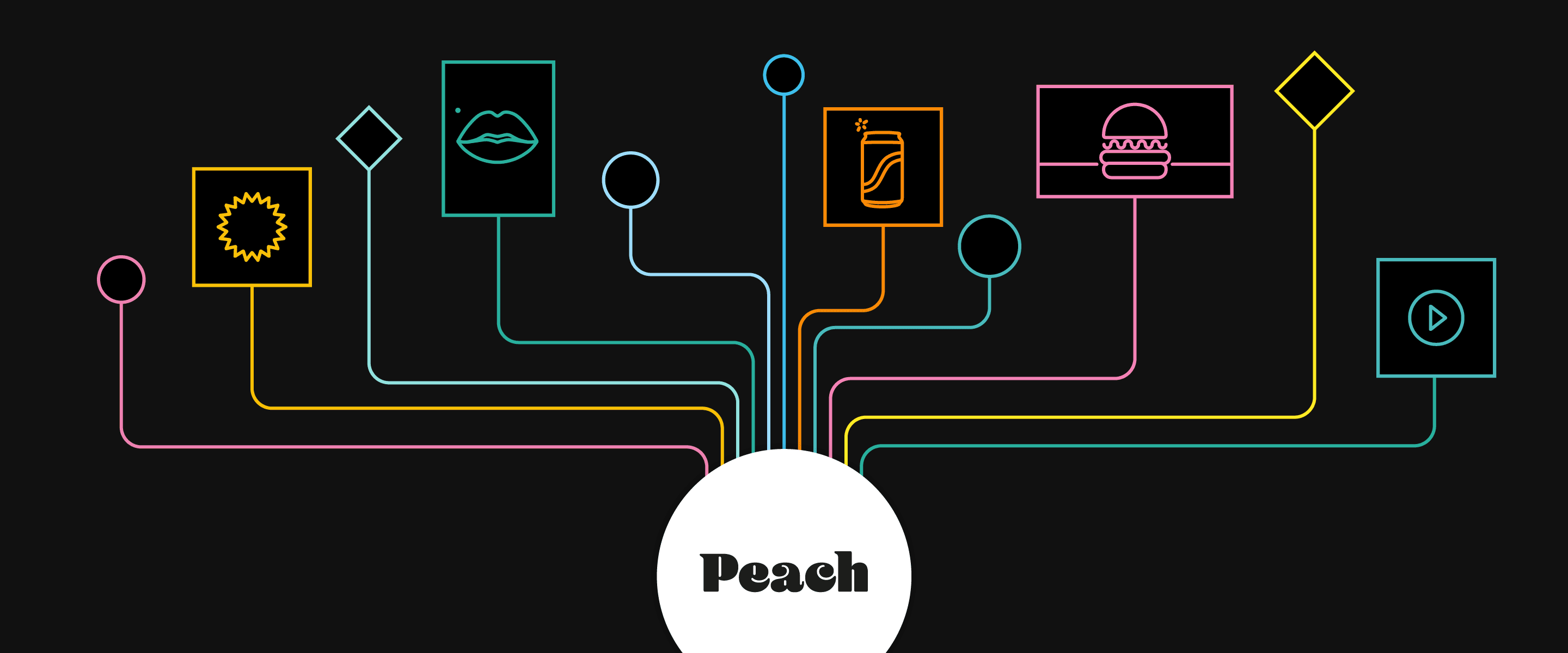
So what does the Peach Developer API do? This release of the API is designed to programmatically (ad tech folk, this time we mean the original ‘programmatic’ not that other ‘programmatic’) integrate metadata and video assets via public links, then files are quality checked and distributed to broadcasters and platforms. 

Here are some examples of what can be done.

Automate advertising data

Got an internal system at your agency holding your media plan, assets and metadata? Automatically create campaigns, with ad metadata and destinations in Peach to distribute to broadcasters and other destinations.

Faster asset distribution

Stop uploading and downloading files between different ad platforms — with the Peach Developer API a video asset can be pulled into a campaign directly through a public URL. So if the video is on Dropbox, Google Drive or an asset management system they can be directly pulled in, QCed and renditions sent on to destinations — saving you huge amounts of time and avoiding costly mistakes.

Distribute to 40,000+ broadcasters, ad platforms and more

Simplify the distribution of video assets to broadcasters and other destinations. The naming of broadcasters and other destinations can often be inconsistent across the industry and can cause problems — using smart aliases the Peach Developer API works around this.

Developers: what you need to know

  1. The Peach Developer API will initially support automation and integrations for the ‘buy–side’ of the Peach Platform: including creating campaigns, ads and destinations

  2. The API is organized around common REST principles using standard HTTP response codes, authentication and verbs. All requests should be made over SSL. All request and response bodies, including errors, are encoded in JSON.

  3. The initial feature-set provides CRUD functionality for basic entities: Campaigns, Ads, Assets and Destinations.

  4. We’ve provided a set of mapping endpoints allowing you to use custom names for Advertisers, Brands, Destinations and Channels

  5. Video assets can be added into campaigns via public URL (e.g. via Dropbox, Google Drive, asset management systems, etc.)

  6. The API’s data mocking feature allows you to test the APIs using a predefined set of IDs interconnected and synced between all exposed entities – this limits the amount of time needed to integrate with Peach and removes the need of using a test account. 

  7. The rich documentation covers every available endpoint (detailing both requests and responses) and includes a Postman collection providing full–suite test coverage.

  8. Currently the API supports distribution to our huge range of ‘direct destination’ integrations covering broadcasters around the world. It currently excludes activator destinations and ones that require user authorisation. 

For lots more information developers can visit the Peach Developer API page and follow the instructions for registration, authentication and authorization, or contact us for more information.

The Peach Developer API has been many years in the making. The Peach app itself is built on a rich API layer which iterated on a version launched in 2016 and used internally. This is battle hardened stuff. But it takes a lot more to be externally facing, so I’d like to thank Clinton Van Ry, Bartosz Gosiewski and the entire team who built it, the clients who helped us define how it should work and tested earlier internal versions, plus the many people who were excited about the possibilities it would create — including some Peach alumni such as Tadas Tamošauskas, Frank Lakebrink, Tom Walne and many others.

News

Stay ahead of the curve

Curious about the latest in marketing and advertising?
Subscribe to our monthly Promarketers newsletter.

Mar 18, 2026

No more chocolate at breakfast? Navigating the new LHF ad rules this Easter

As ad compliance requirements evolve in 2026, UK confectionery brands face new restrictions on less healthy food (LHF) advertising. With the January 5 watershed now in effect, ad quality assurance systems must validate timing, placement, and product identifiability to avoid clearance failures this Easter season.

Mar 16, 2026

The future of inclusion: How Cape.io powered Virgin Media Television’s fully accessible ad break during the Men’s Six Nations

As Channel 4’s closed-captioning mandate came into effect in March 2026, Cape.io partnered with Virgin Media Television, Omnicom Media Group and VoiceBox to deliver a truly accessible ad break during the Guinness Men’s Six Nations. More than ad compliance, this moment proved that accessibility can operate at the highest level of live sports broadcasting.

Feb 27, 2026

Navigating Channel 4’s 2026 closed caption mandate

As ad compliance requirements tighten across the UK and Europe, closed captioning has evolved from an accessibility checkbox to a strategic necessity. Whether you're managing CTV campaigns or social media creative, automated ad testing for caption quality is no longer optional - it's fundamental to reaching today's fragmented, multi-screen audiences.

The advertising landscape is facing a seismic shift. By March 1, Channel 4 will become the first UK broadcaster to mandate closed captions across all advertising - including linear TV, streaming, and sponsorships.

The mandate is  a redefined standard for global inclusivity. Here is everything you need to know about the new mandate and how to stay ahead of the curve.

Feb 26, 2026

One platform, many realities: How creative automation platforms resolve the global vs. local tension

Scaling global marketing without losing local relevance requires more than brand guidelines and templates - it requires a creative automation platform designed for both global control and local flexibility. Most systems optimize for standardization, but scaling ad creative production across markets demands architecture that enables creative variation and adaptation by local experts without fragmenting brand governance.

Many global advertisers are chasing the same ideal: scale without losing relevance.

Consistency without uniformity.
Efficiency without bureaucracy.

It sounds simple. In practice, it’s one of the hardest tensions to resolve in modern marketing.

The global vs. local challenge isn’t new, but it’s becoming more urgent. As brands expand across markets, channels, and cultures, the question is no longer whether you should scale globally, but how you do so without erasing the nuance that makes marketing effective in the first place.

Everyone is looking for this balance. Very few get it right.

Feb 11, 2026

EPTVI Initiative launches Stage Two to help programmatic TV scale across Europe’s largest advertising markets

Broadcasters, streamers, agencies and ad tech companies including Google Ad Manager, Equativ, Adform, LiveRamp, The Trade Desk, FreeWheel and Cape.io begin work on practical solutions to reduce complexity and speed up adoption.

Feb 4, 2026

The guardrails of growth: Why creative intelligence demands compliance

Generative AI can produce thousands of creative variants, but most compliance systems are still manual, fragmented, and reactive, unable to keep pace with today’s velocity. To move fast without breaking things, the industry needs a new approach: real-time verification, programmatic enforcement, and end-to-end visibility. Embedded inside the stack, not bolted on at the end.

News

Stay ahead of the curve

Curious about the latest in marketing and advertising?
Subscribe to our monthly Promarketers newsletter.

Mar 18, 2026

No more chocolate at breakfast? Navigating the new LHF ad rules this Easter

As ad compliance requirements evolve in 2026, UK confectionery brands face new restrictions on less healthy food (LHF) advertising. With the January 5 watershed now in effect, ad quality assurance systems must validate timing, placement, and product identifiability to avoid clearance failures this Easter season.

Mar 16, 2026

The future of inclusion: How Cape.io powered Virgin Media Television’s fully accessible ad break during the Men’s Six Nations

As Channel 4’s closed-captioning mandate came into effect in March 2026, Cape.io partnered with Virgin Media Television, Omnicom Media Group and VoiceBox to deliver a truly accessible ad break during the Guinness Men’s Six Nations. More than ad compliance, this moment proved that accessibility can operate at the highest level of live sports broadcasting.

Feb 27, 2026

Navigating Channel 4’s 2026 closed caption mandate

As ad compliance requirements tighten across the UK and Europe, closed captioning has evolved from an accessibility checkbox to a strategic necessity. Whether you're managing CTV campaigns or social media creative, automated ad testing for caption quality is no longer optional - it's fundamental to reaching today's fragmented, multi-screen audiences.

The advertising landscape is facing a seismic shift. By March 1, Channel 4 will become the first UK broadcaster to mandate closed captions across all advertising - including linear TV, streaming, and sponsorships.

The mandate is  a redefined standard for global inclusivity. Here is everything you need to know about the new mandate and how to stay ahead of the curve.

Feb 26, 2026

One platform, many realities: How creative automation platforms resolve the global vs. local tension

Scaling global marketing without losing local relevance requires more than brand guidelines and templates - it requires a creative automation platform designed for both global control and local flexibility. Most systems optimize for standardization, but scaling ad creative production across markets demands architecture that enables creative variation and adaptation by local experts without fragmenting brand governance.

Many global advertisers are chasing the same ideal: scale without losing relevance.

Consistency without uniformity.
Efficiency without bureaucracy.

It sounds simple. In practice, it’s one of the hardest tensions to resolve in modern marketing.

The global vs. local challenge isn’t new, but it’s becoming more urgent. As brands expand across markets, channels, and cultures, the question is no longer whether you should scale globally, but how you do so without erasing the nuance that makes marketing effective in the first place.

Everyone is looking for this balance. Very few get it right.

Feb 11, 2026

EPTVI Initiative launches Stage Two to help programmatic TV scale across Europe’s largest advertising markets

Broadcasters, streamers, agencies and ad tech companies including Google Ad Manager, Equativ, Adform, LiveRamp, The Trade Desk, FreeWheel and Cape.io begin work on practical solutions to reduce complexity and speed up adoption.

Feb 4, 2026

The guardrails of growth: Why creative intelligence demands compliance

Generative AI can produce thousands of creative variants, but most compliance systems are still manual, fragmented, and reactive, unable to keep pace with today’s velocity. To move fast without breaking things, the industry needs a new approach: real-time verification, programmatic enforcement, and end-to-end visibility. Embedded inside the stack, not bolted on at the end.

News

Stay ahead of the curve

Curious about the latest in marketing and advertising?
Subscribe to our monthly Promarketers newsletter.

Mar 18, 2026

No more chocolate at breakfast? Navigating the new LHF ad rules this Easter

As ad compliance requirements evolve in 2026, UK confectionery brands face new restrictions on less healthy food (LHF) advertising. With the January 5 watershed now in effect, ad quality assurance systems must validate timing, placement, and product identifiability to avoid clearance failures this Easter season.

Mar 16, 2026

The future of inclusion: How Cape.io powered Virgin Media Television’s fully accessible ad break during the Men’s Six Nations

As Channel 4’s closed-captioning mandate came into effect in March 2026, Cape.io partnered with Virgin Media Television, Omnicom Media Group and VoiceBox to deliver a truly accessible ad break during the Guinness Men’s Six Nations. More than ad compliance, this moment proved that accessibility can operate at the highest level of live sports broadcasting.

Feb 27, 2026

Navigating Channel 4’s 2026 closed caption mandate

As ad compliance requirements tighten across the UK and Europe, closed captioning has evolved from an accessibility checkbox to a strategic necessity. Whether you're managing CTV campaigns or social media creative, automated ad testing for caption quality is no longer optional - it's fundamental to reaching today's fragmented, multi-screen audiences.

The advertising landscape is facing a seismic shift. By March 1, Channel 4 will become the first UK broadcaster to mandate closed captions across all advertising - including linear TV, streaming, and sponsorships.

The mandate is  a redefined standard for global inclusivity. Here is everything you need to know about the new mandate and how to stay ahead of the curve.

Feb 26, 2026

One platform, many realities: How creative automation platforms resolve the global vs. local tension

Scaling global marketing without losing local relevance requires more than brand guidelines and templates - it requires a creative automation platform designed for both global control and local flexibility. Most systems optimize for standardization, but scaling ad creative production across markets demands architecture that enables creative variation and adaptation by local experts without fragmenting brand governance.

Many global advertisers are chasing the same ideal: scale without losing relevance.

Consistency without uniformity.
Efficiency without bureaucracy.

It sounds simple. In practice, it’s one of the hardest tensions to resolve in modern marketing.

The global vs. local challenge isn’t new, but it’s becoming more urgent. As brands expand across markets, channels, and cultures, the question is no longer whether you should scale globally, but how you do so without erasing the nuance that makes marketing effective in the first place.

Everyone is looking for this balance. Very few get it right.

Feb 11, 2026

EPTVI Initiative launches Stage Two to help programmatic TV scale across Europe’s largest advertising markets

Broadcasters, streamers, agencies and ad tech companies including Google Ad Manager, Equativ, Adform, LiveRamp, The Trade Desk, FreeWheel and Cape.io begin work on practical solutions to reduce complexity and speed up adoption.

Feb 4, 2026

The guardrails of growth: Why creative intelligence demands compliance

Generative AI can produce thousands of creative variants, but most compliance systems are still manual, fragmented, and reactive, unable to keep pace with today’s velocity. To move fast without breaking things, the industry needs a new approach: real-time verification, programmatic enforcement, and end-to-end visibility. Embedded inside the stack, not bolted on at the end.

Get in touch

Let us show you what Cape.io can do.

Intelligent Campaign Automation

Cape.io connects up your team, DAM, ad servers, DSPs, tools, and more, so you don’t need to rip and replace.

Copyright © 2026 Cape.io all rights reserved

English

Get in touch

Let us show you what Cape.io can do.

Intelligent Campaign Automation

Cape.io connects up your team, DAM, ad servers, DSPs, tools, and more, so you don’t need to rip and replace.

Copyright © 2026 Cape.io all rights reserved

English

Get in touch

Let us show you what Cape.io can do.

Intelligent Campaign Automation

Cape.io connects up your team, DAM, ad servers, DSPs, tools, and more, so you don’t need to rip and replace.

Copyright © 2026 Cape.io all rights reserved

English