Jul 20, 2021

Automate to eliminate

What if robots aren’t the villains? What if… letting robots do more work allows you to do more of the fun stuff?
Author

Cape.io

Author

Cape.io

This was originally posted on the Peach website. Find out more about the rebrand from Peach to Cape.io.

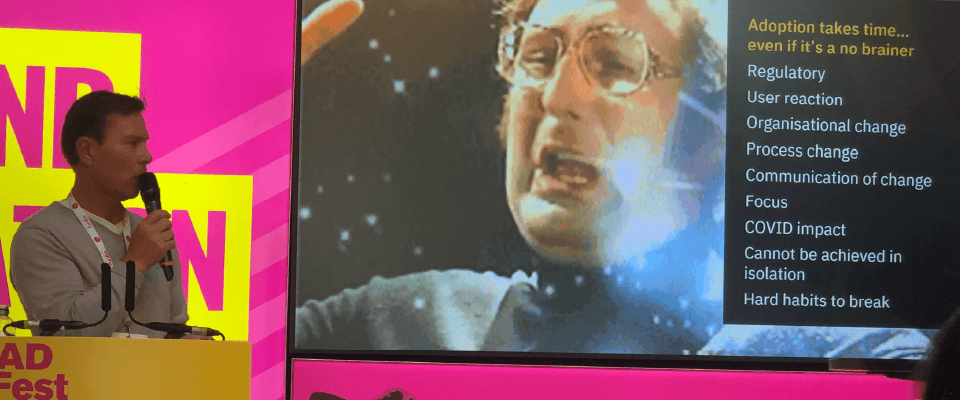
Jason Trout, our Global Chief Digital Officer spoke at Mad//Fest London at the beginning of July at our first #IRL European conference. His session covered the importance for the ad industry to embrace automation and that the fear that it might steal away jobs is unwarranted. 

In 1930, John Maynard Keynes thought we’d be working 30 hours a week and our problem would be too much leisure time. His thinking? Like the 19th century print depicts, he thought we would be able to rely on machines to produce the same output quicker and more efficiently… so we can sit back and chill out. Gosh, we wish. 


Almost 100 years later and we’ve still not reached that point. Instead, overwork is often interpreted as commitment, rather than inefficiency. The visions of reduced working weeks were, whether the authors knew it or not, visions of a more effective workforce. But to admit to doing less work is often interpreted as caring less. 

That perception of not looking dedicated, consequently keeps employees boxed in low value and mundane work instead of requesting the support of faster automated alternatives that free up employees to do higher grade work with less effort, allowing the business to scale upwards. 


Why would I suggest automation if that means I’ll be replaced?  

Conversations about how automation can improve productivity and reduce costs for businesses are often coupled with stories of how automation is taking jobs away from workers.

According to a report by McKinsey Global Institute, less than 5% of jobs consist of activities that can be fully automated.


Far more common will be the automation of constituent activities for a given role. In about 60% of occupations, at least one-third of the activities that make up a specific job could be automated. The good news is that most workers see this automation in a positive light and are keen to take advantage of automation that has the potential to make their work — and their lives — better.

Workers surveyed look forward to spending less time on repetitive manual tasks like data entry, and to spending more time on rewarding aspects of their work. Here’s a look at how automation could do just that — and how organizations are approaching the automation of repetitive tasks for information workers.


As you can see from the graph above the ad industry has the second highest potential to adopt automation, just below accommodation and food services. 


The graph above breaks down that 51% into specific activities where automation can be applied into the ad industry.  


How much time are you wasting? 

According to a Forbes workers survey, 40% of respondents spend a quarter of their work week on repetitive tasks such as emails, data entry and collection. 70% believed that the biggest opportunity to apply automation is to repetitive work, for the ad industry that would be things like approving assets and status update requests. 

Finally, 60% estimated they would in total save 6+ hours of work a week after the introduction of automation to work. This would free them up from admin heavy tasks and realign their focus on creativity and more profitable work. 

Adoption takes time — even though it’s a no brainer 

The business and employee case for automation is obvious. So why are businesses so slow at implementation? Even when the logic is clear it takes commitment. It is a process not a quick fix, requiring time and focus from all parties — like potty training a puppy.  

People have always been averse to change even if they recognise it’s there to benefit them. The changes need to be communicated, understood and then taught. This might require an organisational change which comes with it’s own challenges. 

And, of course, there’s Covid-19 too — and how that may have inadvertently slowed down adoption of automation. Firstly, capital may be required to be reinvested elsewhere for short-term business survival. Secondly, new process training becomes a lot more difficult and time consuming when people are working from home instead of together in the office. Businesses may decide to just pause adoption until employees are back in the office permanently - and who knows really when that could be. 

Nonetheless, it is dangerous to ignore the desperate need for the ad industry to modernise. With the explosion of digital, Connected TV and DOOH, things are only going to become more unbearable. Getting digital campaigns live costs time, energy and morale as media is bottlenecked with repetitive tasks. 

In a survey conducted by CoLab they found that:

  • 61% found sourcing content slow and complex

  • 62% acknowledged poor quality content is in use 

  • 96% use different processes across multiple drop off points

  • 65% had no tracking of where their content has been distributed to 

Our suggestion? Invest and adopt now whilst you’re still able to cope - it is the only answer to long term survival. 

 

News

Stay ahead of the curve

Curious about the latest in marketing and advertising?
Subscribe to our monthly Promarketers newsletter.

Mar 30, 2026

Operationalizing AI in advertising: Why it must be embedded, not bolted on

Operationalizing AI in advertising isn’t about adding another tool to your stack. It’s about embedding intelligence into the systems that govern creative production, compliance, and delivery, so automation scales without creating more operational friction.

Mar 18, 2026

No more chocolate at breakfast? Navigating the new LHF ad rules this Easter

As ad compliance requirements evolve in 2026, UK confectionery brands face new restrictions on less healthy food (LHF) advertising. With the January 5 watershed now in effect, ad quality assurance systems must validate timing, placement, and product identifiability to avoid clearance failures this Easter season.

Mar 16, 2026

The future of inclusion: How Cape.io powered Virgin Media Television’s fully accessible ad break during the Men’s Six Nations

As Channel 4’s closed-captioning mandate came into effect in March 2026, Cape.io partnered with Virgin Media Television, Omnicom Media Group and VoiceBox to deliver a truly accessible ad break during the Guinness Men’s Six Nations. More than ad compliance, this moment proved that accessibility can operate at the highest level of live sports broadcasting.

Feb 27, 2026

Navigating Channel 4’s 2026 closed caption mandate

As ad compliance requirements tighten across the UK and Europe, closed captioning has evolved from an accessibility checkbox to a strategic necessity. Whether you're managing CTV campaigns or social media creative, automated ad testing for caption quality is no longer optional - it's fundamental to reaching today's fragmented, multi-screen audiences.

The advertising landscape is facing a seismic shift. By March 1, Channel 4 will become the first UK broadcaster to mandate closed captions across all advertising - including linear TV, streaming, and sponsorships.

The mandate is  a redefined standard for global inclusivity. Here is everything you need to know about the new mandate and how to stay ahead of the curve.

Feb 26, 2026

One platform, many realities: How creative automation platforms resolve the global vs. local tension

Scaling global marketing without losing local relevance requires more than brand guidelines and templates - it requires a creative automation platform designed for both global control and local flexibility. Most systems optimize for standardization, but scaling ad creative production across markets demands architecture that enables creative variation and adaptation by local experts without fragmenting brand governance.

Many global advertisers are chasing the same ideal: scale without losing relevance.

Consistency without uniformity.
Efficiency without bureaucracy.

It sounds simple. In practice, it’s one of the hardest tensions to resolve in modern marketing.

The global vs. local challenge isn’t new, but it’s becoming more urgent. As brands expand across markets, channels, and cultures, the question is no longer whether you should scale globally, but how you do so without erasing the nuance that makes marketing effective in the first place.

Everyone is looking for this balance. Very few get it right.

Feb 11, 2026

EPTVI Initiative launches Stage Two to help programmatic TV scale across Europe’s largest advertising markets

Broadcasters, streamers, agencies and ad tech companies including Google Ad Manager, Equativ, Adform, LiveRamp, The Trade Desk, FreeWheel and Cape.io begin work on practical solutions to reduce complexity and speed up adoption.

News

Stay ahead of the curve

Curious about the latest in marketing and advertising?
Subscribe to our monthly Promarketers newsletter.

Mar 30, 2026

Operationalizing AI in advertising: Why it must be embedded, not bolted on

Operationalizing AI in advertising isn’t about adding another tool to your stack. It’s about embedding intelligence into the systems that govern creative production, compliance, and delivery, so automation scales without creating more operational friction.

Mar 18, 2026

No more chocolate at breakfast? Navigating the new LHF ad rules this Easter

As ad compliance requirements evolve in 2026, UK confectionery brands face new restrictions on less healthy food (LHF) advertising. With the January 5 watershed now in effect, ad quality assurance systems must validate timing, placement, and product identifiability to avoid clearance failures this Easter season.

Mar 16, 2026

The future of inclusion: How Cape.io powered Virgin Media Television’s fully accessible ad break during the Men’s Six Nations

As Channel 4’s closed-captioning mandate came into effect in March 2026, Cape.io partnered with Virgin Media Television, Omnicom Media Group and VoiceBox to deliver a truly accessible ad break during the Guinness Men’s Six Nations. More than ad compliance, this moment proved that accessibility can operate at the highest level of live sports broadcasting.

Feb 27, 2026

Navigating Channel 4’s 2026 closed caption mandate

As ad compliance requirements tighten across the UK and Europe, closed captioning has evolved from an accessibility checkbox to a strategic necessity. Whether you're managing CTV campaigns or social media creative, automated ad testing for caption quality is no longer optional - it's fundamental to reaching today's fragmented, multi-screen audiences.

The advertising landscape is facing a seismic shift. By March 1, Channel 4 will become the first UK broadcaster to mandate closed captions across all advertising - including linear TV, streaming, and sponsorships.

The mandate is  a redefined standard for global inclusivity. Here is everything you need to know about the new mandate and how to stay ahead of the curve.

Feb 26, 2026

One platform, many realities: How creative automation platforms resolve the global vs. local tension

Scaling global marketing without losing local relevance requires more than brand guidelines and templates - it requires a creative automation platform designed for both global control and local flexibility. Most systems optimize for standardization, but scaling ad creative production across markets demands architecture that enables creative variation and adaptation by local experts without fragmenting brand governance.

Many global advertisers are chasing the same ideal: scale without losing relevance.

Consistency without uniformity.
Efficiency without bureaucracy.

It sounds simple. In practice, it’s one of the hardest tensions to resolve in modern marketing.

The global vs. local challenge isn’t new, but it’s becoming more urgent. As brands expand across markets, channels, and cultures, the question is no longer whether you should scale globally, but how you do so without erasing the nuance that makes marketing effective in the first place.

Everyone is looking for this balance. Very few get it right.

Feb 11, 2026

EPTVI Initiative launches Stage Two to help programmatic TV scale across Europe’s largest advertising markets

Broadcasters, streamers, agencies and ad tech companies including Google Ad Manager, Equativ, Adform, LiveRamp, The Trade Desk, FreeWheel and Cape.io begin work on practical solutions to reduce complexity and speed up adoption.

News

Stay ahead of the curve

Curious about the latest in marketing and advertising?
Subscribe to our monthly Promarketers newsletter.

Mar 30, 2026

Operationalizing AI in advertising: Why it must be embedded, not bolted on

Operationalizing AI in advertising isn’t about adding another tool to your stack. It’s about embedding intelligence into the systems that govern creative production, compliance, and delivery, so automation scales without creating more operational friction.

Mar 18, 2026

No more chocolate at breakfast? Navigating the new LHF ad rules this Easter

As ad compliance requirements evolve in 2026, UK confectionery brands face new restrictions on less healthy food (LHF) advertising. With the January 5 watershed now in effect, ad quality assurance systems must validate timing, placement, and product identifiability to avoid clearance failures this Easter season.

Mar 16, 2026

The future of inclusion: How Cape.io powered Virgin Media Television’s fully accessible ad break during the Men’s Six Nations

As Channel 4’s closed-captioning mandate came into effect in March 2026, Cape.io partnered with Virgin Media Television, Omnicom Media Group and VoiceBox to deliver a truly accessible ad break during the Guinness Men’s Six Nations. More than ad compliance, this moment proved that accessibility can operate at the highest level of live sports broadcasting.

Feb 27, 2026

Navigating Channel 4’s 2026 closed caption mandate

As ad compliance requirements tighten across the UK and Europe, closed captioning has evolved from an accessibility checkbox to a strategic necessity. Whether you're managing CTV campaigns or social media creative, automated ad testing for caption quality is no longer optional - it's fundamental to reaching today's fragmented, multi-screen audiences.

The advertising landscape is facing a seismic shift. By March 1, Channel 4 will become the first UK broadcaster to mandate closed captions across all advertising - including linear TV, streaming, and sponsorships.

The mandate is  a redefined standard for global inclusivity. Here is everything you need to know about the new mandate and how to stay ahead of the curve.

Feb 26, 2026

One platform, many realities: How creative automation platforms resolve the global vs. local tension

Scaling global marketing without losing local relevance requires more than brand guidelines and templates - it requires a creative automation platform designed for both global control and local flexibility. Most systems optimize for standardization, but scaling ad creative production across markets demands architecture that enables creative variation and adaptation by local experts without fragmenting brand governance.

Many global advertisers are chasing the same ideal: scale without losing relevance.

Consistency without uniformity.
Efficiency without bureaucracy.

It sounds simple. In practice, it’s one of the hardest tensions to resolve in modern marketing.

The global vs. local challenge isn’t new, but it’s becoming more urgent. As brands expand across markets, channels, and cultures, the question is no longer whether you should scale globally, but how you do so without erasing the nuance that makes marketing effective in the first place.

Everyone is looking for this balance. Very few get it right.

Feb 11, 2026

EPTVI Initiative launches Stage Two to help programmatic TV scale across Europe’s largest advertising markets

Broadcasters, streamers, agencies and ad tech companies including Google Ad Manager, Equativ, Adform, LiveRamp, The Trade Desk, FreeWheel and Cape.io begin work on practical solutions to reduce complexity and speed up adoption.

Get in touch

Let us show you what Cape.io can do.

Intelligent Campaign Automation

Cape.io connects up your team, DAM, ad servers, DSPs, tools, and more, so you don’t need to rip and replace.

Copyright © 2026 Cape.io all rights reserved

English

Get in touch

Let us show you what Cape.io can do.

Intelligent Campaign Automation

Cape.io connects up your team, DAM, ad servers, DSPs, tools, and more, so you don’t need to rip and replace.

Copyright © 2026 Cape.io all rights reserved

English

Get in touch

Let us show you what Cape.io can do.

Intelligent Campaign Automation

Cape.io connects up your team, DAM, ad servers, DSPs, tools, and more, so you don’t need to rip and replace.

Copyright © 2026 Cape.io all rights reserved

English