/
/
/
How to scale programmatic DOOH creative: solving the format bottleneck
How to scale programmatic DOOH creative: solving the format bottleneck
DOOH offers brands huge creative potential, from hyper-local messaging to dynamic campaigns triggered by weather, time, and location. But bringing that potential to life means producing an enormous number of creative variations across a fragmented landscape of screen sizes and formats.
Key takeaways
Programmatic buying can scale media quickly, but creative still has to work across countless screen sizes, aspect ratios and publisher formats.
Centralise formats and automate resizing so creative can adapt to different environments without rebuilding every version manually.
Cape.io’s modular DOOH workflow makes it possible to edit a single campaign and generate format-specific creative, making geo- and weather-triggered campaigns more practical at scale.

Programmatic Digital Out-of-Home (pDOOH) is experiencing massive growth. pDOOH investment to grow by an average of 49% over the next 18 months, with 91% of buyers folding it into their broader digital and programmatic planning—up from just 41% two years ago. Nearly a third of advertisers are setting aside entirely new budgets for it.
The money, the inventory, and the media buying infrastructure have all matured rapidly. However, creative production has not kept pace.
Today, media teams can buy impressions across thousands of screens, dayparts, and geographies with a few clicks. But the actual creative appearing on those screens is still built the way it was a decade ago: one designer, one file, one size at a time. The buying side sprinted ahead, leaving creative production standing at the start line.
That gap is where omnichannel campaigns quietly lose their edge and it is exactly the problem Cape.io’s Creative Automation platform was built to solve.
A huge challenge in PDOOH it that Creative processes have not kept up in pDOOH: the resizing bottleneck
Ask any brand or agency running a serious DOOH campaign what their biggest hurdle is, and the answer is rarely the media plan. It is turning a single piece of creative into the hundreds of size and aspect-ratio variants that a real DOOH buy demands.
A standard campaign requires:
Landscape 16:9 for roadside digital billboards.
Tall portrait screens for transit and retail environments.
Ultra-wide strips for malls and airports.
Square formats for street furniture.
Dozens of publisher-specific, non-standard dimensions.
Done manually, this is not a design task; it is a versioning nightmare. Every format requires its own crop, layout logic, and Quality Assurance (QA) pass. This eats up production timelines, introduces brand inconsistencies, and turns a simple late-stage client edit into a full reproduction cycle.
This constraint caps what is creatively possible. Brands have the ideas for geo-relevant, time-of-day-aware, dynamically personalized out-of-home advertising. But producing the sheer volume of assets required has historically been too slow and expensive to attempt at scale.
How Cape.io accelerates DOOH production
Cape.io is built around a simple premise: design a campaign once, and let the platform handle the multiplication. Here is how we remove the format bottleneck entirely.
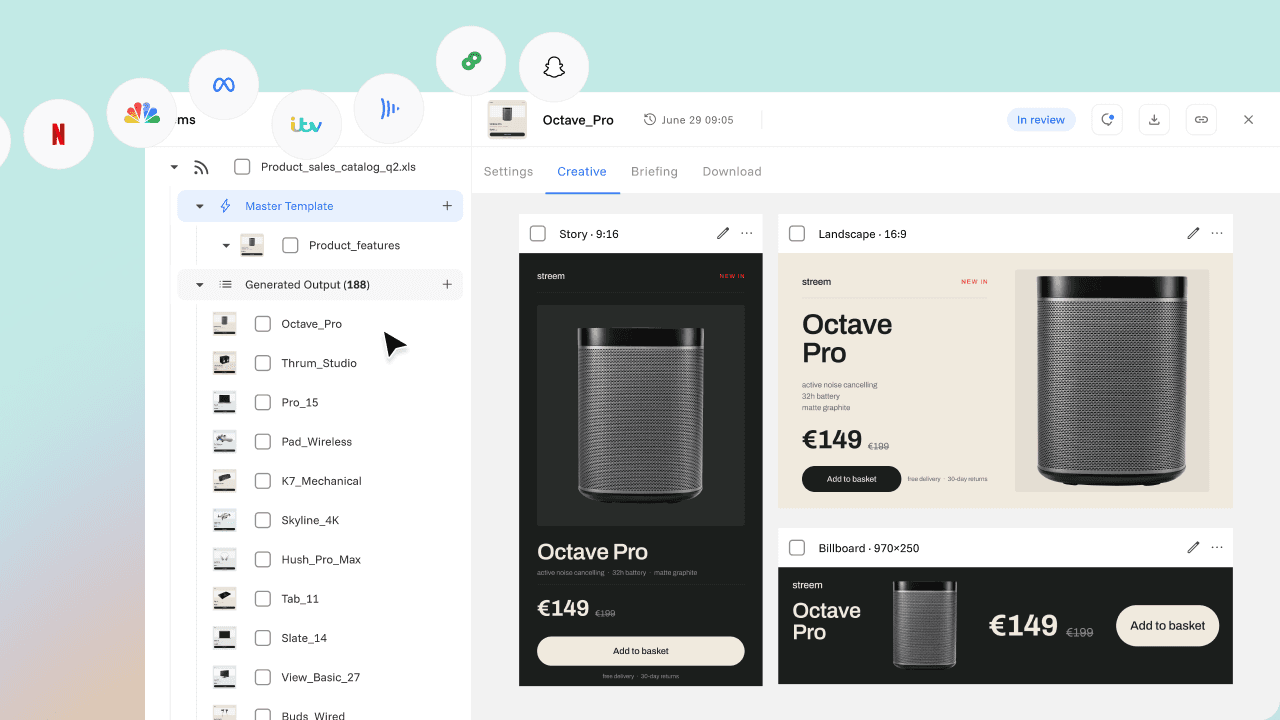
Start from a centralized format library: Cape.io's library covers the full spread of DOOH and pDOOH sizes, including publisher-specific non-standards. Instead of briefing a designer to rebuild a layout, you select every format your campaign needs directly from the library in one pass.
Algorithmic style transfer: Cape.io automatically applies its layout logic, typography, colors, and imagery placement to every selected format. Hundreds of individual builds become a single design decision. Designers retain full manual control to fine-tune specific placements.
Dynamic templating and bulk editing: Once a campaign is built, you are no longer rebuilding creative; you are editing it. Change a headline or swap a background, and that change propagates across every format in the set instantly.
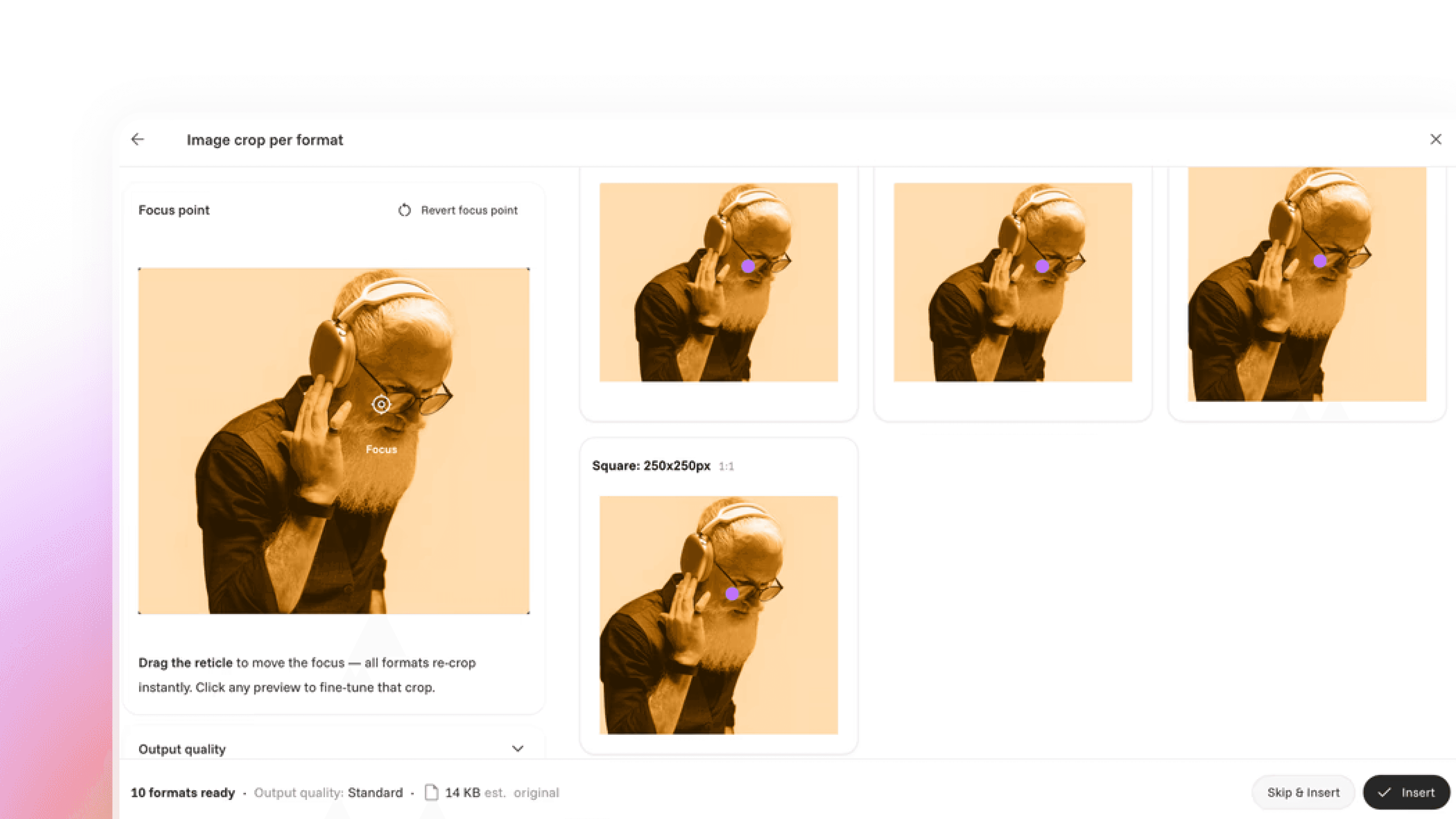
AI-powered Resizing: DOOH format diversity is brutal on scaling. A hero shot composed for a 16:9 billboard rarely works on a 9:16 transit screen. Cape.io's AI autocropper analyzes each background image and intelligently determines how to scale and reposition it per format, keeping the subject in frame and the composition intact. Again Designers still have final edit power
Now that we can change DOOH creative at hyper speed, ehen building and updating creative becomes this fast, campaigns can finally use variation such as tailoring messaging by geography, weather, or time of day, instead of settling for a single static execution.
DOOH Creative Automation use cases by persona
Enterprise Brands with high OOH spend: Production lead times no longer dictate creative ambition. Localized, dayparted, and always-current creative becomes achievable across your full screen footprint, without increasing in-house design headcount.
Creative and Media agencies: Templating and bulk edits allow a single production team to service more client campaigns and handle revisions without the linear scaling in billable hours. Margin is protected without sacrificing quality.
DOOH publishers: Better creative is better for Every non-standard format in your inventory becomes easier for advertisers to fill with high-quality, on-brand creative, removing a major barrier
DOOH DSPs (Demand-Side Platforms): Faster creative turnarounds mean fewer stalled campaigns and more inventory activated with properly sized assets, directly improving fill rates and campaign performance.
Frequently Asked Questions (FAQ)
What is Programmatic DOOH (pDOOH)? Programmatic DOOH is the automated buying, selling, and delivery of digital out-of-home advertising. It allows marketers to purchase billboard and transit screen inventory in real-time based on specific data triggers like weather, time of day, or audience foot traffic.
How does Creative Automation improve DOOH campaigns? Creative automation software eliminates manual ad versioning. By using AI cropping and dynamic templating, brands can instantly generate hundreds of DOOH ad sizes from a single master design, allowing for faster campaign launches and hyper-localized messaging.
Can Cape.io handle non-standard publisher ad sizes? Yes. Cape.io features a comprehensive format library that includes both standard DOOH dimensions and specific, non-standard publisher requirements, allowing designers to automatically scale creative to fit any screen accurately.
Ready to scale your out-of-home advertising? Get in touch with our team to talk through your DOOH format list and see the Cape.io platform in action.
Category