Best creative automation platforms in 2026 (and who each one is actually for)
Best creative automation platforms in 2026 (and who each one is actually for)
Every vendor in this space will tell you they're the best. None of them can all be right.
The truth is more useful than a single winner: creative automation platforms solve genuinely different problems. Some are built for enterprise governance. Some are built for speed. Some barely touch anything beyond paid social. Picking the wrong category for your actual bottleneck is the expensive mistake, not picking the "wrong" brand.
Key takeaways
There is no single “best” creative automation platform. Different tools solve different bottlenecks across production, media and workflow.
Choose technology around the problem you need to solve, whether that is high-volume creative production, global brand consistency, media optimisation or end-to-end campaign execution.
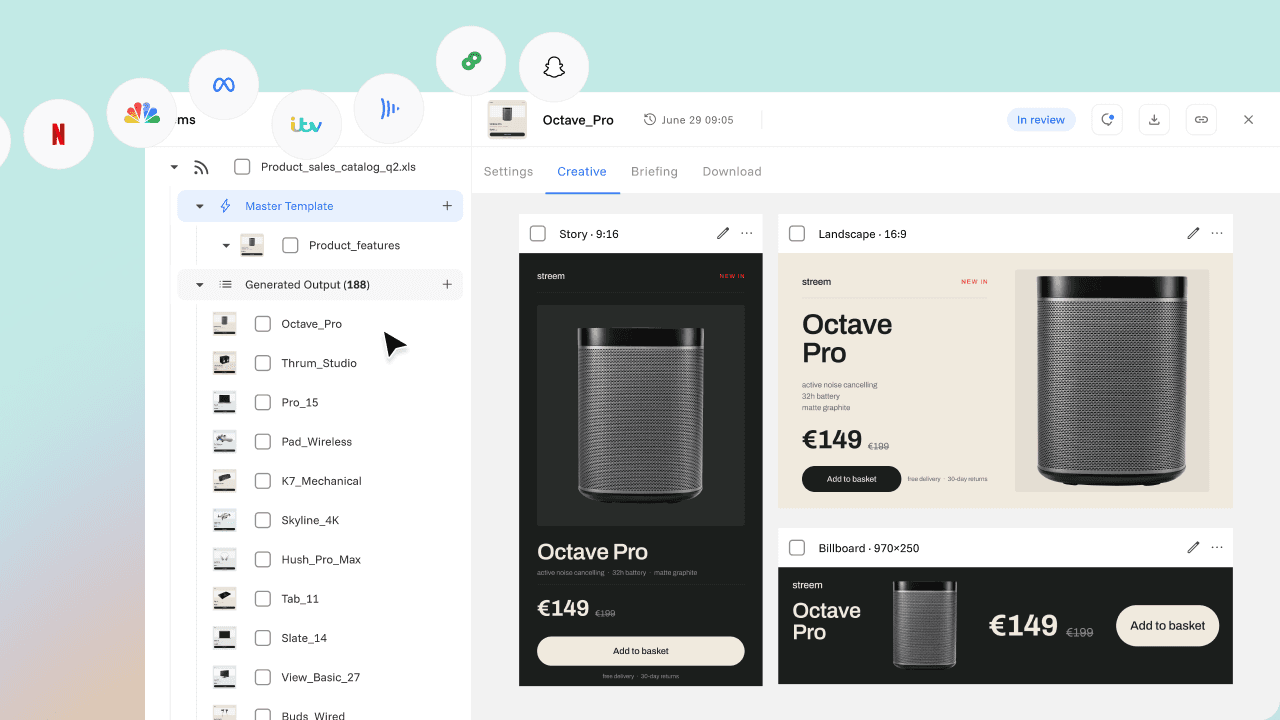
Creative and media optimisation work best together. Cape.io connects creative production, compliance validation, campaign planning and activation so teams can manage more of the advertising lifecycle in one workflow.
Here’s a practical breakdown of who’s good at what in 2026, and where the category is actually heading.
Quick comparison
Platform | Best for | Team size |
|---|---|---|
Cape.io | Full campaign lifecycle, one platform | Mid-market to enterprise |
Celtra | Enterprise creative governance | Enterprise |
Smartly.io | Paid social creative + media buying | Enterprise |
Bannerflow | Omnichannel banner/display production | Mid-market to enterprise |
Storyteq | Brand-controlled creative collaboration at scale | Mid-market |
Rocketium | High-volume creative production speed | Mid-market |
Creatify | AI-assisted creative, smaller budgets | Small to mid-market |
Hunch | Intelligence layer on your existing stack | Any (add-on) |
What “creative automation” actually means now
A few years ago, this meant one thing: resize a banner ad automatically instead of rebuilding it by hand. That’s still part of it. But the category has stretched.
The best platforms now touch AI-assisted creative generation, dynamic personalization, automated compliance checks, and direct publishing across social, display, CTV, and broadcast. The pressure driving that expansion isn’t subtle: more channels, less time, and increasingly, actual legal requirements around what you can and can’t put in an ad.
How we picked this list
We didn’t rank every platform on every feature. That approach produces long, useless lists where everyone “wins” at something vague. Instead, we looked at five things that actually separate these tools from each other:
Creative flexibility and quality - real creative control, or templated output that looks it
AI capability - embedded into decisions, or bolted on as a nice-to-have
Workflow and governance - how well it handles approvals and brand consistency across teams
Scale and reliability - does it hold up at high volume, multiple markets
Support depth - how much hands-on help you actually get
No platform wins all five. That’s not a flaw in the list, it’s the point.
The platforms
Cape.io - best for connecting the full campaign lifecycle
Most platforms on this list specialize in one part of the process, usually creative production. Cape.io’s bet is different: connect planning, creative production, compliance validation, and activation into one workflow, across social, display, CTV, and broadcast. Cape.io also has the trust layer built in, allowing you to derisk creative seamlessly.
If your actual bottleneck isn’t “we can’t make creative fast enough” but “creative, media, and compliance all live in separate tools that don’t talk to each other,” this is the gap Cape.io is built to close.
Find out how Cape.io connects your workflow
Celtra - best for enterprise creative governance
Celtra has built a genuine reputation in enterprise creative management, particularly for teams juggling multiple brands, markets, or product lines that all need to stay on-brand without slowing production to a crawl.
Its marketer-empowerment tools let non-technical teams produce creative without looping in design or dev every time, which matters a lot once you’re managing creative at real scale.
Best for: enterprise teams where consistency across many stakeholders is the actual challenge.
Smartly.io - best for paid social tied directly to media spend
Smartly.io’s strength is specific: creative production tightly integrated with paid social and programmatic media buying, CTV included as a digital ad format within that.
Where it’s less built out is the broadcast and Advanced TV side, linear delivery, broadcaster trafficking, that’s a different discipline from digital CTV buying, and not the core of what Smartly.io does.
Best for: performance and paid social teams where media spend and creative are managed together.
Bannerflow - best for omnichannel banner and display production
DSPs and social channels, and publishes to DOOH through named partners, making it a genuinely strong option for teams producing at volume across many digital and out-of-home placements.
Its core focus stays digital and DOOH rather than extending into broadcast or linear TV, worth knowing if your media mix includes traditional broadcast alongside digital.
Best for: brands and agencies producing high volumes of display, social, and DOOH creative.
Storyteq - best for brand-controlled collaboration across markets
Storyteq’s whole design leans into a specific problem: how do you let local or regional teams adapt creative without breaking what head office signed off on?
It holds up at real scale too, with solid AI-assisted production behind the governance layer, not just a collaboration tool bolted onto a thin creative engine.
Best for: multi-region brands balancing central control with local adaptation.
Rocketium - best for production speed at volume
Rocketium is built around getting a lot of creative variants out fast, without giving up the governance controls larger teams still need to keep things on-brand.
If speed and volume are your actual constraint, this is a strong option that doesn’t force a tradeoff against control.
Best for: teams prioritizing speed over deep multi-market controls.
Creatify - best for AI-assisted creative on a smaller budget
Creatify’s feature set has grown considerably beyond a simple AI-assisted generator, it’s a genuinely capable option now, not just a stripped-down starter tool.
It’s still particularly strong value for smaller teams and tighter budgets who don’t want to commit to a large enterprise platform, without being limited to only the basics anymore.
Best for: smaller teams wanting AI-assisted creative without a big platform commitment.
Hunch - best as an intelligence layer, not a replacement
Hunch does something smart: instead of claiming to out-feature every established DCO platform, it positions itself as a layer that adds creative-level intelligence, whether that’s on top of an existing platform or as a standalone starting point.
It doesn’t require an existing DCO tool to get value from, which makes it flexible for teams supplementing a current stack and teams starting fresh with a narrower, intelligence-first approach alike.
Best for: teams wanting a focused intelligence layer on an existing platform, not a switch.
So which one should you actually pick?
Start with where your process actually breaks, not with a feature checklist.
Disconnected tools across planning, production, compliance, and activation? A full-lifecycle platform like Cape.io solves more of the real problem than another point solution.
Bottleneck is speed and volume? Rocketium is built for exactly that.
Bottleneck is brand governance across markets? Celtra or Storyteq.
Creative lives inside paid social spend? Smartly.io.
Budget rules out an enterprise platform? Creatify, or a layer like Hunch on top of what you’ve already got.
It’s also worth being honest about what you don’t need. Not every team needs multi-region governance. Matching the platform to your actual bottleneck beats matching it to the longest feature list.
Frequently asked questions
What's the difference between creative automation and DCO?
Creative automation is the broad category: producing and scaling creative without rebuilding everything manually. Dynamic creative optimization (DCO) is a more specific piece within that, automatically adjusting creative in real time based on audience or context. Most creative automation platforms include some DCO capability, not every DCO tool covers the full workflow.
Do I need a full platform, or just a production tool?
Depends entirely on where the pain actually is. If production is your only bottleneck and everything else already works, a focused tool might be enough. If planning, compliance, and activation are all disconnected too, a full-lifecycle platform solves more of the real problem.
How much does AI actually matter here?
It varies a lot between platforms, from AI as an assistive feature to AI embedded directly into decisions like what to produce or how to personalize it. Neither is automatically better. It depends how much control you want to keep versus hand off.
Can these platforms actually help with ad compliance?
Some can, and it's a growing part of the category as regulatory requirements around advertising keep expanding. Not every platform on this list treats compliance as core. Worth confirming directly with any vendor before assuming it's covered.
Before you commit to anything
There’s no single “best” platform in 2026, only the best fit for where your process actually breaks down. Enterprise governance, paid social integration, production speed, and full-lifecycle connectivity are genuinely different problems, and the tools built to solve them reflect that.
If your gap is connecting creative production to compliance and activation across channels, that’s exactly what Cape.io is built for.
Category