/
/
/
Cannes Lions 2026: AI grew up, now the industry has to learn to trust it
Cannes Lions 2026: AI grew up, now the industry has to learn to trust it
The conversation has shifted from whether AI can automate advertising to whether automated campaign execution can actually be trusted.

Key takeaways
Advertising AI is moving beyond content generation towards automated campaign execution across channels, workflows and markets.
For AI to operate at campaign scale, it needs to connect planning, creative production, compliance, activation and optimisation, not just generate another asset.
Agentic AI can take on repetitive campaign operations while people retain responsibility for strategy, creativity, governance and accountability.

Every year, people leave Cannes Lions asking the same question: What was the biggest trend?
This year, my answer wasn't a new AI model, another retail media announcement, or the latest creative tool.
The conversation has shifted from whether AI can automate advertising to whether automated campaign execution can actually be trusted.
That may sound like a subtle difference, but it's one that will define the next chapter of our industry.
Because marketers aren't struggling to generate more content anymore. They're struggling to deliver increasingly complex campaigns without broken workflows, compliance issues, or wasted media spend.
Here are my five biggest takeaways from this year's festival.
1. Cannes Lions is becoming as much a technology festival as an advertising festival
Walking the Croisette, it was impossible not to notice how much the balance has shifted.
AI companies, cloud providers, measurement platforms, retail media networks, broadcasters, and martech vendors now occupy as much attention as agencies and creative businesses.
Advertising has expanded beyond a great idea.
It's about the infrastructure that allows great ideas to scale across dozens of channels, markets, and creative variations.
Technology isn't replacing creativity.
It's becoming the operating system behind it.
2. AI hasn't replaced human connection
Ironically, the more AI dominated conversations, the more obvious it became that people still value being together.
Thousands of marketers travelled across the world - not because AI couldn't summarise the conference, but because relationships, trust, and shared experiences still matter.
The busiest places weren't necessarily the keynote stages.
They were the cafés, beach clubs, terraces, and hotel lobbies where conversations happened naturally.
As AI becomes more capable, human connection becomes even more valuable.
3. Agentic AI has moved from concept to reality
Last year, most conversations focused on generative AI.
This year, the discussion evolved.
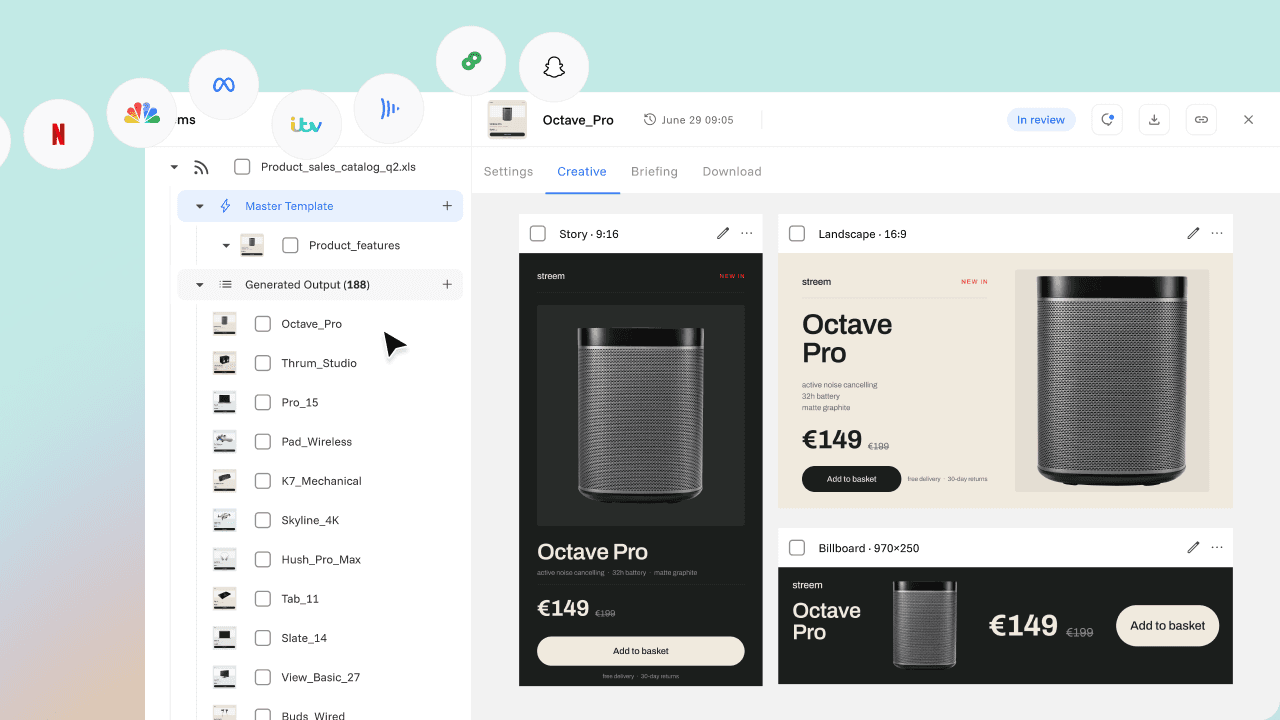
Brands are now thinking about AI that can orchestrate entire workflows - from campaign planning and creative production to compliance, activation, and optimisation.
That's a much bigger opportunity.
But it's also where the industry's biggest challenge begins.
Every CMO is quietly asking the same question:
Can automated campaign execution actually be trusted to run at scale without breaking?
Legacy automation has left many marketers sceptical. Campaigns still suffer from disconnected workflows, dropped feeds, compliance issues discovered after media spend begins, and systems that fail to learn from previous performance.
The next generation of automation has to do more than accelerate work.
It has to earn trust.
That means helping teams run campaigns more efficiently, catch compliance issues before they air, learn from every activation, and make better decisions over time.
Trust is the destination.
4. Human-in-the-loop is making AI better
One message came through consistently across the week.
Brands want AI handling the repetitive work while people remain responsible for judgment, creativity, governance, and accountability.
Taste still matters.
Context still matters.
Trust still requires human oversight.
The winners will be the ones that combine intelligent automation with effective human decision-making.
5. Attention is fragmenting, but TV is becoming more accessible
Celebrity and influencer marketing continues to grow because attention has become harder than ever to earn.
As content volumes explode, trusted creators help brands cut through the noise in ways algorithms alone cannot.
At the same time, TV is becoming more accessible to businesses of every size.
The launch of Universal Ads in the UK by ITV, Sky, and Channel 4, alongside Walmart Connect's acquisition of Vibe.co in the US, signals another important shift: premium TV advertising is becoming easier for small and medium-sized businesses to buy.
That means more advertisers, more creative versions, more media destinations - and significantly more operational complexity.
Which brings us back to the same question.
How do you manage all of that at scale without increasing risk?
The bigger picture
The biggest lesson from Cannes was that AI is becoming embedded across every layer of campaign operations.
The competitive advantage will come from building campaign workflows that brands can trust - workflows that connect creative production, validation, and media execution while catching issues before campaigns launch, learning from every activation, and continuously improving over time.
At Cape.io, we call this Intelligent Campaign Automation.
The next chapter of advertising will be defined by who can trust AI to deliver better campaigns at scale.
Category