Operationalizing AI in advertising: Why it must be embedded, not bolted on

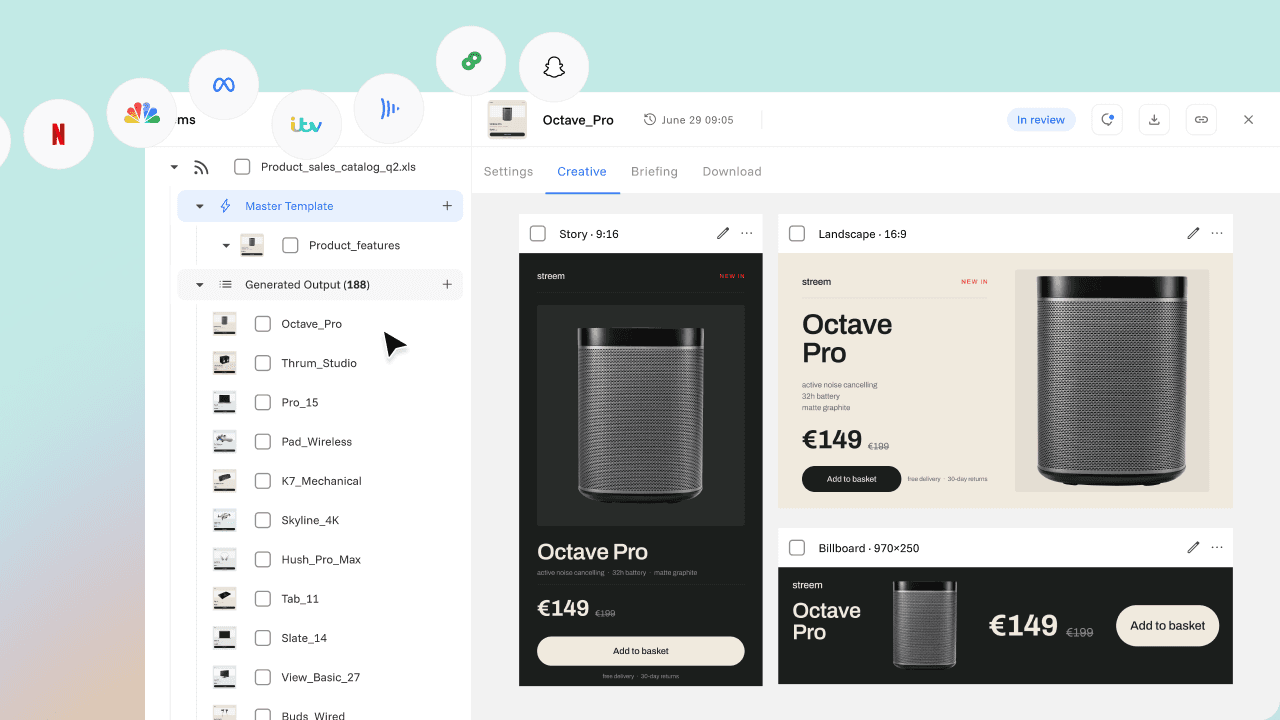
Operationalizing AI in advertising isn’t about adding another tool to your stack. It’s about embedding intelligence into the systems that govern creative production, compliance, and delivery, so automation scales without creating more operational friction.

Author

Pouya

Pouya

Author

Pouya

Every week, there’s another shiny proof of concept that promises to “fix” creative production with a few prompts. A few clicks, a few variants, a few impressed nods.

As Product Owner tasked with implementing AI intelligently into our core products and actually making it stick for our users, I’ve learned that once you look under the hood, these 'bolt-on' features usually fail on a larger scale because programmatic isn’t simply a one-stop shop, but a supply chain that spans creative production, compliance, trafficking, and activation.

The 5% reality check

This gap isn’t just anecdotal; recent findings from Gartner highlight a sobering reality: among marketers using generative AI, only 5% are seeing significant gains on business outcomes. As Sharon Cantor Ceurvorst, VP of Research at Gartner, puts it: CMOs who simply bolt AI onto legacy processes will fail to drive growth.

That matches what we see in Product at Cape.io. The programmatic lifecycle is complicated with fragmented silos and moving parts. An asset moves from creative teams to compliance, through trafficking, and across a gauntlet of DSPs and SSPs, each with its own rigid specs and shifting policies.

If AI sits outside the workflow, it doesn’t save time. It creates a new category of work: manual oversight, exception handling, and reworks across creative operations and ad production.

The shift from feature to infrastructure

The AI that actually matters in 2026 isn't a tool at all. It’s infrastructure, it’s embedded AI that lives inside creative and advertising workflows. A bolt-on tool produces an output, whereas infrastructure implementations produce an outcome.

For AI to be operational, it has to live inside the Source of Truth. It needs to be woven into the versioning, the QA, and the delivery metadata. Embedded AI can react to real constraints, not just prompts, but an agentic ecosystem built in. It can be understood that a 15-second CTV spot for a specific European market carries different rules than a US social cut, because the workflow and data make those differences.

At Cape.io, we’ve focused on this from pre-production to post-production philosophy with Cape Check & Go. It’s not an add-on you check at the end of the day; it’s a trained layer of intelligence that monitors the entire flow. It’s about "de-risking" production.

Bridging the creative-media divide

We talk about the “crumbling wall” between creative and media. It only stays down if both sides share the same data.

Embedded AI becomes the bridge. QA can’t be the final gate in programmatic - it has to run continuously as assets change shape and format. Variants only matter if you can trace them to outcomes and track every version through the life of a campaign. And as cookies vanish, the advantage shifts to teams that combine privacy-safe media signals with durable creative metadata. Connecting those inputs, even at an aggregated level, gives teams a reliable way to link creatives and markets within a holistic performance-led workflow and focus on changes that iterate faster with less wasted on spend and time.

The bottom line

The competitive advantage in 2026 isn't about who can generate the most content or bolt on the latest LLM to a product. In an era of abundance, content is cheap. The winners will be the teams that can operate creatively at a programmatic scale without losing control.

AI shouldn't be a separate creation tool that sits on your desktop. It should be the quiet engine that ensures every asset, from the first brief to the final impression, is compliant, performant, and ready for the real world.

Start embedding intelligence into your infrastructure.

News

Stay ahead of the curve

Curious about the latest in marketing and advertising?
Subscribe to our monthly Promarketers newsletter.

May 8, 2026

Brazil votes. Cape.io already knows what that means.

Cape.io has powered Brazil's general elections for four editions, managing 500 channels and 155 million voters. Here's how we do it.

Apr 23, 2026

Agentic AI vs AI wrappers vs custom AI: How to choose your path

You're about to spend $500K on an AI initiative. You've got 3 options on the table, and they'll lead you to wildly different places. Pick wrong, and you're rebuilding in 18 months. Pick right, and you'll have a system that scales, costs less to maintain, and actually does what executives promised.

The choice is between wrapping existing AI models, building custom AI solutions from scratch, or going agentic. Most teams don't understand the real trade-offs until they're locked into the wrong one.

Mar 30, 2026

Operationalizing AI in advertising: Why it must be embedded, not bolted on

Operationalizing AI in advertising isn’t about adding another tool to your stack. It’s about embedding intelligence into the systems that govern creative production, compliance, and delivery, so automation scales without creating more operational friction.

Mar 18, 2026

No more chocolate at breakfast? Navigating the new LHF ad rules this Easter

As ad compliance requirements evolve in 2026, UK confectionery brands face new restrictions on less healthy food (LHF) advertising. With the January 5 watershed now in effect, ad quality assurance systems must validate timing, placement, and product identifiability to avoid clearance failures this Easter season.

Mar 16, 2026

The future of inclusion: How Cape.io powered Virgin Media Television’s fully accessible ad break during the Men’s Six Nations

As Channel 4’s closed-captioning mandate came into effect in March 2026, Cape.io partnered with Virgin Media Television, Omnicom Media Group and VoiceBox to deliver a truly accessible ad break during the Guinness Men’s Six Nations. More than ad compliance, this moment proved that accessibility can operate at the highest level of live sports broadcasting.

Feb 27, 2026

Navigating Channel 4’s 2026 closed caption mandate

As ad compliance requirements tighten across the UK and Europe, closed captioning has evolved from an accessibility checkbox to a strategic necessity. Whether you're managing CTV campaigns or social media creative, automated ad testing for caption quality is no longer optional - it's fundamental to reaching today's fragmented, multi-screen audiences.

The advertising landscape is facing a seismic shift. By March 1, Channel 4 will become the first UK broadcaster to mandate closed captions across all advertising - including linear TV, streaming, and sponsorships.

The mandate is  a redefined standard for global inclusivity. Here is everything you need to know about the new mandate and how to stay ahead of the curve.

News

Stay ahead of the curve

Curious about the latest in marketing and advertising?
Subscribe to our monthly Promarketers newsletter.

May 8, 2026

Brazil votes. Cape.io already knows what that means.

Cape.io has powered Brazil's general elections for four editions, managing 500 channels and 155 million voters. Here's how we do it.

Apr 23, 2026

Agentic AI vs AI wrappers vs custom AI: How to choose your path

You're about to spend $500K on an AI initiative. You've got 3 options on the table, and they'll lead you to wildly different places. Pick wrong, and you're rebuilding in 18 months. Pick right, and you'll have a system that scales, costs less to maintain, and actually does what executives promised.

The choice is between wrapping existing AI models, building custom AI solutions from scratch, or going agentic. Most teams don't understand the real trade-offs until they're locked into the wrong one.

Mar 30, 2026

Operationalizing AI in advertising: Why it must be embedded, not bolted on

Operationalizing AI in advertising isn’t about adding another tool to your stack. It’s about embedding intelligence into the systems that govern creative production, compliance, and delivery, so automation scales without creating more operational friction.

Mar 18, 2026

No more chocolate at breakfast? Navigating the new LHF ad rules this Easter

As ad compliance requirements evolve in 2026, UK confectionery brands face new restrictions on less healthy food (LHF) advertising. With the January 5 watershed now in effect, ad quality assurance systems must validate timing, placement, and product identifiability to avoid clearance failures this Easter season.

Mar 16, 2026

The future of inclusion: How Cape.io powered Virgin Media Television’s fully accessible ad break during the Men’s Six Nations

As Channel 4’s closed-captioning mandate came into effect in March 2026, Cape.io partnered with Virgin Media Television, Omnicom Media Group and VoiceBox to deliver a truly accessible ad break during the Guinness Men’s Six Nations. More than ad compliance, this moment proved that accessibility can operate at the highest level of live sports broadcasting.

Feb 27, 2026

Navigating Channel 4’s 2026 closed caption mandate

As ad compliance requirements tighten across the UK and Europe, closed captioning has evolved from an accessibility checkbox to a strategic necessity. Whether you're managing CTV campaigns or social media creative, automated ad testing for caption quality is no longer optional - it's fundamental to reaching today's fragmented, multi-screen audiences.

The advertising landscape is facing a seismic shift. By March 1, Channel 4 will become the first UK broadcaster to mandate closed captions across all advertising - including linear TV, streaming, and sponsorships.

The mandate is  a redefined standard for global inclusivity. Here is everything you need to know about the new mandate and how to stay ahead of the curve.

News

Stay ahead of the curve

Curious about the latest in marketing and advertising?
Subscribe to our monthly Promarketers newsletter.

May 8, 2026

Brazil votes. Cape.io already knows what that means.

Cape.io has powered Brazil's general elections for four editions, managing 500 channels and 155 million voters. Here's how we do it.

Apr 23, 2026

Agentic AI vs AI wrappers vs custom AI: How to choose your path

You're about to spend $500K on an AI initiative. You've got 3 options on the table, and they'll lead you to wildly different places. Pick wrong, and you're rebuilding in 18 months. Pick right, and you'll have a system that scales, costs less to maintain, and actually does what executives promised.

The choice is between wrapping existing AI models, building custom AI solutions from scratch, or going agentic. Most teams don't understand the real trade-offs until they're locked into the wrong one.

Mar 30, 2026

Operationalizing AI in advertising: Why it must be embedded, not bolted on

Operationalizing AI in advertising isn’t about adding another tool to your stack. It’s about embedding intelligence into the systems that govern creative production, compliance, and delivery, so automation scales without creating more operational friction.

Mar 18, 2026

No more chocolate at breakfast? Navigating the new LHF ad rules this Easter

As ad compliance requirements evolve in 2026, UK confectionery brands face new restrictions on less healthy food (LHF) advertising. With the January 5 watershed now in effect, ad quality assurance systems must validate timing, placement, and product identifiability to avoid clearance failures this Easter season.

Mar 16, 2026

The future of inclusion: How Cape.io powered Virgin Media Television’s fully accessible ad break during the Men’s Six Nations

As Channel 4’s closed-captioning mandate came into effect in March 2026, Cape.io partnered with Virgin Media Television, Omnicom Media Group and VoiceBox to deliver a truly accessible ad break during the Guinness Men’s Six Nations. More than ad compliance, this moment proved that accessibility can operate at the highest level of live sports broadcasting.

Feb 27, 2026

Navigating Channel 4’s 2026 closed caption mandate

As ad compliance requirements tighten across the UK and Europe, closed captioning has evolved from an accessibility checkbox to a strategic necessity. Whether you're managing CTV campaigns or social media creative, automated ad testing for caption quality is no longer optional - it's fundamental to reaching today's fragmented, multi-screen audiences.

The advertising landscape is facing a seismic shift. By March 1, Channel 4 will become the first UK broadcaster to mandate closed captions across all advertising - including linear TV, streaming, and sponsorships.

The mandate is  a redefined standard for global inclusivity. Here is everything you need to know about the new mandate and how to stay ahead of the curve.

Get in touch

Let us show you what Cape.io can do.

Intelligent Campaign Automation

Cape.io connects up your team, DAM, ad servers, DSPs, tools, and more, so you don’t need to rip and replace.

Copyright © 2026 Cape.io all rights reserved

English

Get in touch

Let us show you what Cape.io can do.

Intelligent Campaign Automation

Cape.io connects up your team, DAM, ad servers, DSPs, tools, and more, so you don’t need to rip and replace.

Copyright © 2026 Cape.io all rights reserved

English

Get in touch

Let us show you what Cape.io can do.

Intelligent Campaign Automation

Cape.io connects up your team, DAM, ad servers, DSPs, tools, and more, so you don’t need to rip and replace.

Copyright © 2026 Cape.io all rights reserved

English