The creative-media singularity: Bridging open and closed ecosystems
We are entering the era of the Creative-Media Singularity, a state where creative intelligence and media execution fluidly combine across every single channel. Achieving it requires moving past the fragmented point solutions of yesterday.

For years, enterprise brands have treated digital advertising as a game of two halves. On one side, you have the closed ecosystems, which are the social walled gardens where targeting is swift and creative needs to be hyper-personalized. On the other, you have the open internet, which is the world of Connected TV (CTV), programmatic display, and linear broadcast, driven by scale, technical specifications, and distribution.
Because these environments grew up on different technology stacks, brands naturally built separate teams, separate workflows, and separate budgets to manage them.
But in a modern, AI-native landscape where creative has become the single strongest determinant of media performance, this division is no longer just inefficient. It is actively destructive to your return on ad spend (ROAS).
We are entering the era of the Creative-Media Singularity, a state where creative intelligence and media execution fluidly combine across every single channel. Achieving it requires moving past the fragmented point solutions of yesterday.
The friction: data locked in silos
The primary obstacle to modern campaign velocity is organizational and technical friction. Marketers find themselves caught between point solutions: some platforms excel strictly at social optimization, while legacy ad servers double down on digital infrastructure but struggle to deliver on full-funnel orchestration.
When your technology forces you to choose a single lane, your data gets trapped. You run one isolated creative workflow for your social teams and a completely independent distribution process for your advanced TV and broadcast teams.
This ecosystem fragmentation creates a severe blind spot. If a creative asset is driving massive conversion spikes on social media, that insight remains invisible to the media buyers managing your programmatic CTV buy. By the time your teams manually pull, cross-reference, and normalize those performance reports weeks later, the consumer momentum is gone, the creative has fatigued, and media budget has been wasted.
You cannot achieve a true creative-media singularity if your intelligence is structurally siloed.
Omnichannel is about normalization, not just distribution
There is a common misconception that omnichannel advertising simply means having the ability to push an ad to multiple places at once. Real omnichannel orchestration isn't a delivery function; it is a translation function.
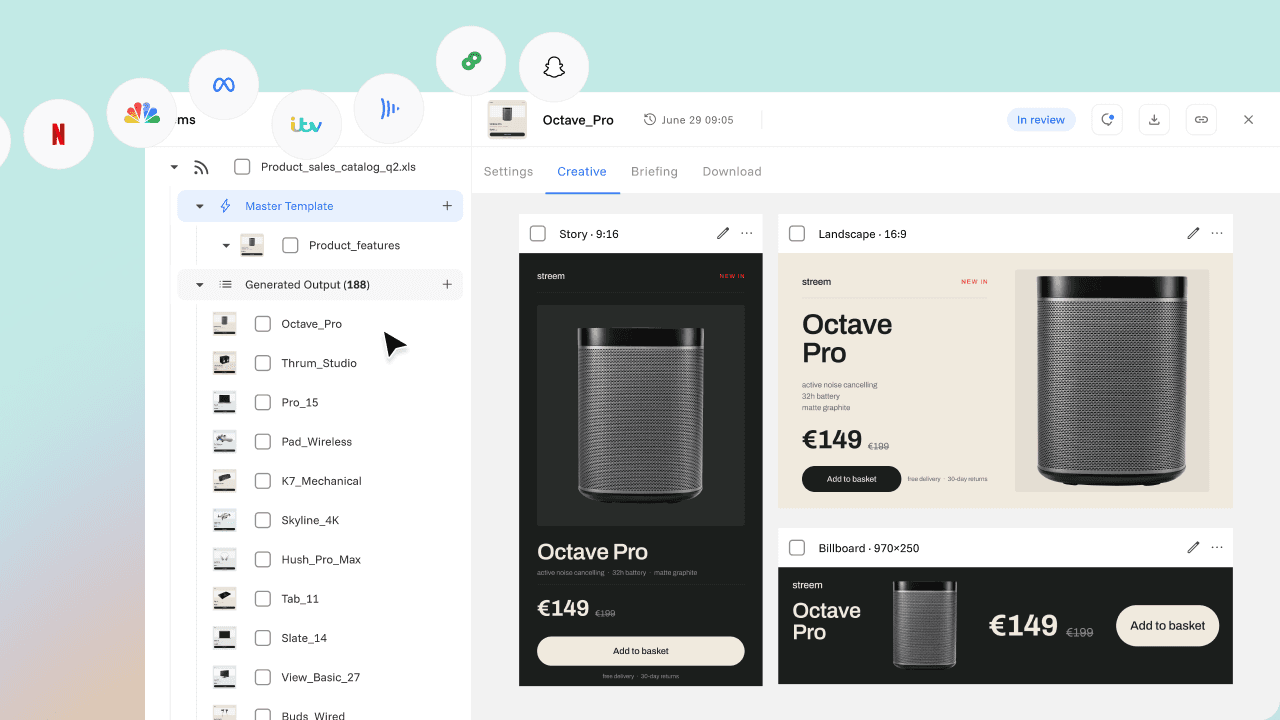
True orchestration requires an underlying infrastructure that unifies creative production, compliance validation, and media activation across both open and closed ecosystems simultaneously. It means operating seamlessly across thousands of destinations, ranging from major social platforms to hundreds of broadcast and CTV networks.
The magic happens when you normalize data across these environments in real time. When your system reads and structures performance signals across diverse channels into a single source of truth, your creative workflow becomes a continuous learning loop.
What this looks like in practice: A predictive performance signal or an audience engagement spike detected on a TikTok campaign instantly informs an automated creative adjustment, layout resize, or budget reallocation for your streaming ads on Hulu or linear broadcast networks.
Bridging the walled gardens and the open web
To survive the next wave of adtech evolution, enterprise marketing organizations must transcend the cultural and technical disconnects between design and media teams.
Advantage will no longer come from merely producing a higher volume of content. It will come from building a unified ecosystem where creative assets are generated with baked-in compliance, pre-flight tested for impact, and continuously optimized across the entire customer journey.
The walled gardens and the open web will always remain distinct environments for consumers. But for enterprise brands, your technology infrastructure must treat them as a single, harmonious canvas. That is the promise of the creative-media singularity, and it is the only way to build campaigns at machine speed while keeping humans firmly in command.
Stop bleeding ROAS to fragmented workflows.
If your creative and media teams are still operating on mismatched tools and isolated metrics, you are burning media budget. Book a brief, 15-minute strategy briefing with a Cape.io specialist to see how we can unify your campaign lifecycle from production to cross-channel activation.
Category